Showing posts with label crime fiction. Show all posts

Friday, October 24, 2008

What are you reading? Week 5: Back on the crime fiction beat

Last week, we bid adieu to our friends Nick and Norah and took a tentative step back into crime fiction with the "comedic crime" of Carl Hiaasen. Specifically, his newspaper caper book, Basket Case.

I have to admit, while Basket Case was enjoyable, it lost a little steam toward the end. As I noted last time, the plot of the book appealed to me because the book was set in South Florida and also because the lead character was a journalist. Hiaasen did a great job of painting a newspaper scene, and I really learned a lot from reading the book in that regard. Unfortunately, while his scene-setting when it came to SoFla was decent, it didn't really make me feel like I was back home (I'm from FL, FYI), and a lot of the names used seemed fake and/or forced, which is exactly the opposite of what I'm trying to do with my book. Overall, the plot resolved itself too easily and neatly. I won't spoil the final plot twist, but it left me wanting. Additionally, the "unexpected" romance between protagonist Jack Tagger and his editor Emma came off as unnatural and predictable. Emma's initially painted as a nervous, antsy and neurotic shrew -- so why is the rebellious and cantankerous Jack suddenly drawn to her? Why does she kiss him randomly? It didn't feel right. Understandably, building a functional romantic dynamic is hard, especially when the characters start off as opposing forces. But there didn't seem to be enough time spent on the "Moonlighting"-style moments, where the two opposing characters are at each other's throats but still flirting somewhat. Overall, the book is what it set out to be: a breezy read for someone looking for something entertaining and slight between serious books.

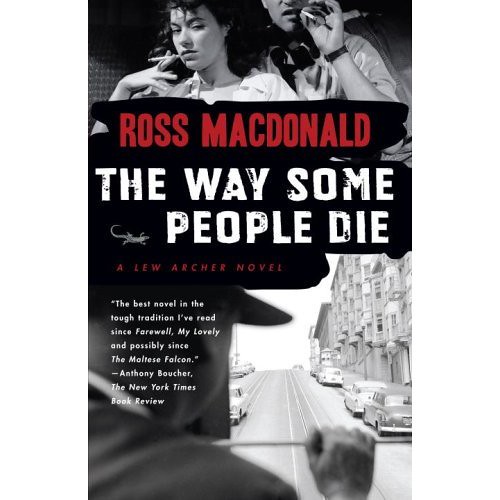
Once I finished Basket Case, though, I was a little desperate. My to-read pile had dwindled to a stack of Ellroy books (more on that later) and Ross MacDonald's The Way Some People Die. The latter was given to me by a friend that works in publishing, but I'd read very little about MacDonald or any of his work. Well, I was pleasantly surprised.


I've gone on and on about my favorite contemporary crime authors -- Pelecanos, Lehane, Connelly, etc. But I've said little about my favorite old school, first generation crime writers. Obviously, Raymond Chandler is atop that list. For a long time after reading his entire output (gold stars next to Farewell, My Lovely, The Big Sleep and The Long Goodbye), I was left wondering if there was a true and proper heir to the colorful, stylized and just plain cool detective novels Chandler created, starring the archetypal gumshoe, Philip Marlowe. For a time, I thought Michael Connelly was the guy, but after a few Bosch books (great as they were), I realized that Connelly was more about a tight, forceful plot and less about the atmospheric and literary strengths that Chandler reveals in his work. Well, Ross MacDonald is it.

Like Chandler, MacDonald chronicles the adventures of a sharp, do-right PI. In MacDonald's case, the guy's name is Lew Archer. Like Marlowe, Archer is a strong believer in right and wrong and finds himself in sticky situations that involve subterfuge, mistaken identities and murder. In The Way Some People Die, Archer is for all intents and purposes a Marlowe clone. But that's fine. And based on what little I've read about the series, I know he eventually evolves into something else. But for someone who was craving more Chandler, MacDonald provides the perfect fix.

While Chandler's work is more about painting a scene and colorful language, MacDonald is also equally about plot. So -- in crude terms -- not only does it read like something cool and interesting is going on, but you also can follow the story and understand who the characters are, a flaw I found in most of Chandler's work, but one I was willing to overlook because the ride was so much fun.

The Way Some People Die starts simply enough -- an aging mother begs detective Lew Archer to find her lovely twentysomething daughter Galatea (otherwise known as Galley), who hasn't been in touch for over two months. What follows is a tale of drug-smuggling, prostitution, murder and multiple double-crosses. It reads like a great, old movie, with the requisite femme fatale, gangster villains and surprising turncoats. If you like mysteries, this is a keeper.

Additionally, like most of Chandler's work, The Way Some People Die is a relatively quick read, clocking in at a little over 270 pages (coincidentally, right around where I'd like SILENT CITY to land, when I finish it. I managed to talk my friend to toss a few more MacDonald books my way, so I wouldn't be surprised to see me writing about him a lot more in this here space. Well, unless I go on an Ellroy tear.


Which is highly likely.

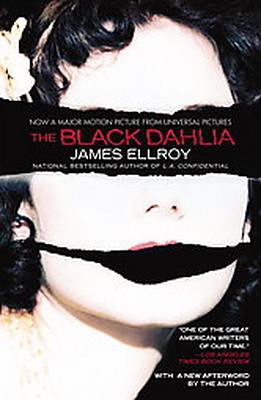
I've had an interesting relationship with the works of James Ellroy. I've always been a fan. My Dark Places (nonfiction) and Ellroy's Lloyd Hopkins trilogy of detective novels are books I think of often and remember really enjoying when I read them. But for whatever reason, I could never bring myself to dive into his more lauded work, namely the "L.A. Quartet" of books, which consist of The Black Dahlia, The Big Nowhere, L.A. Confidential and White Jazz. I tried reading Dahlia a few years back and stalled about 20 pages in. I'm a big believer that if you can't get past the first 20-30 pages of a book, if you're not driven to keep reading it, you're better off just putting it down for a while and moving on to something else. The spark might just not be there. Recently, having finished The Way Some People Die and without another MacDonald book, I picked up Dahlia again. Why Dahlia, specifically? Well, I needed the material to be redeemed in some way. The Brian De Palma-directed movie based on the book was horrible, and I needed to wash that taste out of my mouth. Additionally, Dahlia kicks off the previously mentioned Quartet, so it seemed like as good a place as any to dive into Ellroy.

Great decision. Ellroy is in top form with Dahlia, shrugging off the slight awkwardness and stiff pacing of his earlier novels to create a book that is true neo-noir. As most should know, the book is a fictionalized account of the real Black Dahlia murder. I'm barely 100 pages in, but I've already reached that point where you can't put the book down and all you want to do is curl up and read until you're done. And then, ideally, have another book at the ready. I'll have more concrete thoughts on the book in the next installment, I'm sure, but suffice to say, Dahlia is a pleasure to read. I almost want to kick myself for not plowing through it years ago. It also made me want to "fix" the movie, so expect a post later this week which features me re-casting the entire thing. If I find the time, of course.

Enough about me, though. What are you reading?

Wednesday, October 08, 2008

Can a bad review kill your career? Short version: Yes

At least Murderati thinks so:

There's one time in particular when an author is particularly vulnerable to the effects of a devastating review, and that's when you are a debut author. An editor who takes on a first-time novelist is taking a risk on someone who's untried in the marketplace. The editor hopes, of course, that the debut novel will be wildly successful, or at a minimum, earn back its advance And to increase the chances of its success, this editor will talk up the book to the sales force. As the pub date approaches, she hopes that in-house enthusiasm for the book builds, because that enthusiasm gets transferred to booksellers, who will be convinced to increase their orders. Hefty orders mean more exposure, better displays, and of course better sales. Imagine you are that debut author, and your novel "FIRST TIME OUT" has been bought with a generous advance. Imagine that the publishing house is telling you this is going to be an important book. Imagine that they have decided to give it a big push, with major ads and an author tour.

Then imagine that your first review appears in Publishers Weekly, and they pronounce it a disaster. They call your publisher a house of idiots for buying it.

Now your editor looks like a dope. The enthusiasm at your publishing house suddenly deflates like a popped balloon. Everyone there feels a bit embarrassed, not just for you, but for themselves. The big bookstore orders don't come in. Costco and Walmart take a pass on it. Even before your book goes on sale, it already feels like a big failure and an expensive mistake.

Those promised ads never materialize. And even though they do send you on book tour, every time you meet a bookseller, you just know they're looking at you and thinking, "oh, so you're the author whom PW called illiterate." And you feel like such a loser.

I have to agree here. If you're established, your reputation and career can withstand a few middling and out-and-out bad reviews -- look at some of the stalwarts of modern crime fiction like Lehane, Pelecanos and Price. Not all their books were critical darlings. Heck, EW gave Pelecanos' latest a pretty negative write-up (not that EW is the ba-all-end-all in literary circles, mind you, but I digress) and not many people liked Lehane's Shutter Island. But at both points in each author's career, these guys were/are already established. Had Pelecanos gotten ripped when A Firing Offense came out, he might not be writing today. At least, it'd be harder for him to get published.

Especially if your editor has gone out on a limb for you and really pushed to get you published, an initial wave of negative reviews will, as the post says, make the editor doubt themselves and also weaken their arguments internally to get the book some support. And, let's face it. Without marketing support, a first-time author is going to have trouble laying claim to any of the marketplace. I know that sounds number-crunchy and corporate, but it's the truth.

This post is particularly relevant to me because SILENT CITY is my first novel, and if it does find a home where an editor decides it's worth publishing, it really needs reviewer support to make any kind of dent with readers. Crime fiction readers are pretty insular, so you really need to court the key literary publications and also the crime fiction tastemakers. A bad review from a key person in the field and, while you may not be sunk fully, you'll definitely be behind the eightball.

As a reader, though, how strong an influence do reviews have on your buying habits? Where do you find the best reviews?

Friday, September 26, 2008

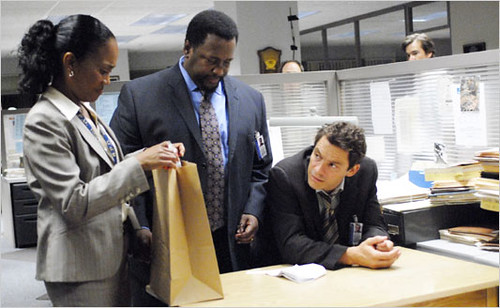
Watching the Detectives: TV cops and private eyes through the years


The Onion AV Club has an excellent article running down the best, worst and most overlooked private detective TV series over the last 50-odd years. The article, which spans about three "pages" of content, is impressive because it not only lists which shows are of quality, but groups them based on structure -- classic private eye shows, shows with a more character-driven slant and shows that are more focused on the portrayal of urban decay and the role of the police and their allies. It serves as a great Cliff's Notes for the history of the genre in televised form, and makes for a quick, informative read. An interesting read for anyone who enjoys crime fiction, on screen or on the page.

Most interesting to me, though, was their list of top series, which capped off the piece. I've excerpted it here:

1. Columbo

columbo

It may not be the most thematically deep detective series ever aired, but Columbo has been reliably entertaining for going on 50 years now, offering mysteries based on unexpected minutiae, along with the iconic clash between too-clever snobs and the working-class drudge who always outlasts them.

2. Homicide: Life On The Street

homicide

The Wire is the most profound cop show of all time, but Homicide is the most profound mystery-based cop show, dealing with all the bureaucratic rot and existential futility that The Wire did, but through the prism of the detective series building-block: the case.

3. Law & Order

law and order

The formula has long been diluted by spin-offs, rip-offs, and repeats, but there's no greater testament to the enduring quality of Law & Order than this: when a channel-surfer lands on an episode of L&O, it's hard not to keep watching all the way through to the final chung-chung.

4. Veronica Mars

veronica mars

Weak ratings and a creatively confused third season killed one of the decade's best series—detective or otherwise—before its time, but the two season-length mysteries Veronica Mars presented before its downfall stand among TV's finest, both in terms of their narrative twists and the way they mapped out the mood of their times.

5. Prime Suspect

prime suspect

The polar opposite of the "cozy" mystery is the hard-boiled one, and TV detective series don't get much harder than this British import, which sees crime as a continuum, with all of its characters—including its heroine—spread out across the line.

A strong list, no doubt. I'd argue that The Wire merits a place, beyond a mention in the Homicide blurb (although, that show is great and worth the investment in its own right). I've got Prime Suspect on my NetFlix queue, so I'm looking forward to that and giving Twin Peaks a solid chance (I've only seen a few episodes here and there). I was a little surprised to see Veronica Mars on here, but I've heard a lot of good things from friends about it, so maybe it's worth a shot. The article also doesn't make mention of The Shield, which struck me as odd.

Still, the article is well worth a read. Thanks to Zombie for the heads up.

Who are your favorite TV detectives? Least favorite?

Saturday, September 20, 2008

What makes a crime novel a crime novel? The continued genre vs. literary debate


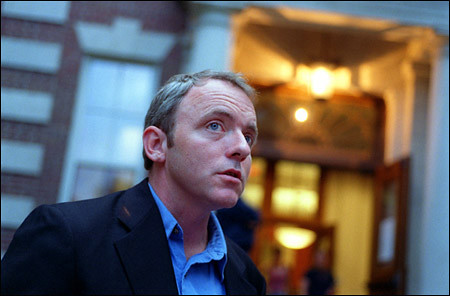
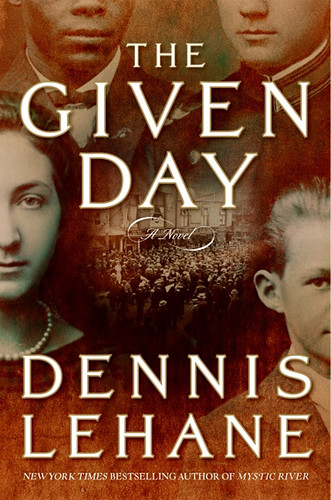
The New York Times has a glowing review of Dennis Lehane's latest, The Given Day, which takes place in the early 20th century, during the historic Boston police strike.


Now, I want to preface this post by explaining that I'm a huge Lehane fan. Specifically, I love his Kenzie/Gennaro detective novels, which kicked off his writing career. His later work, especially Mystic River, was still of high quality, but to me lacked the same verve and energy of his first six novels. But my beef isn't with Lehane -- he's probably written a great book. I plan on reading it and expect to like it. He's one of my favorite contemporary authors. My issue is with this bit from the review:

No more thinking of Mr. Lehane as an author of detective novels that make good movies (“Gone, Baby, Gone”) and tell devastatingly bleak Boston stories (“Mystic River”). He has written a majestic, fiery epic that moves him far beyond the confines of the crime genre.

Shades of Doctorow and Dreiser surround Mr. Lehane’s choice of 1919 as the time for this expansive story. It is not simply the relatively unexplored eventfulness of that year that makes “The Given Day” so far reaching; it’s the relentless fierce-terrible nature of the turmoil on parade.

Now, just what irks me about this review? I can't say it fully struck me until I read David Montomery's post over at Crime Fiction Dossier, so I'll let him speak up first:

One line leapt out of me from the review and stuck with me: "He has written a majestic, fiery epic that moves him far beyond the confines of the crime genre."

I've been thinking about that statement since I read it, wondering exactly what the confines of the crime genre are. And near as I can come up with, a crime novel has to have a crime (either past or future) play an important part in the plot, or else it somehow has to deal with crime or the aftermath of crime in a significant way. Other than that, I think anything is fair game.

As I indicated, I haven't read The Given Day. But judging by the description and the reviews I've read, the book involves the lives of police officers, a terrorist attack, spying, bomb-throwing anarchists, suspense, corruption, anti-union violence...Well, damn, that sounds a lot like a crime novel to me.

It's almost like Ms. Maslin (and I wouldn't be surprised if other critics wrote something similar) is embarrased to admit that she really liked and admired a book of significant literary achievement -- that just happened to be a crime novel.

We saw some of this reaction earlier this year with Richard Price's superb Lush Life, another novel of literary prowess that, oh yeah, was a crime novel.

I haven't read The Given Day, either. I don't know if it's any good, or about any of the specific plot points in the book. But, I do know that there is some level of crime in the book. Doesn't that make it, to some degree, a crime novel? Why is this, and not, say, Mystic River or Coronado or Darkness, Take My Hand, a "literary" work, and therefore better than Lehane's earlier work? More importantly, why should there even be that distinction? Why can't a book just be good, whether it's a crime novel or not?

I'd argue that Lehane is finally stepping into a world that has already been populated by the previously mentioned Richard Price and, more importantly, George Pelecanos, whose last few novels have only peripherally dealt with a crime but instead spent more time painting a picture for the reader of a city or society in decay. Are Pelecanos' works less "literary" because they're still set in the modern day and involve drug deals and stick-ups as a way of showing how our world is melting down? If he'd set his books in the 1800s, would he gain more literary praise? My guess is probably. And that, to me, is really annoying. And, to push the joke a bit, more criminal.


Just because a work of prose, or a screenplay, involves a crime or deals with crime shouldn't lessen the literary or artistic value. The idea that suddenly, Lehane, who has been writing solid novels since he first got published, is a more important author because he's no longer writing a straight-up detective piece is silly, and insulting to those of us that spend time reading crime fiction not just because we find the genre interesting, but because the books in the genre we choose to read are, well, pretty damn good.

I didn't fully intend for this post to become a rant against the literary vs. genre bias -- I brought that up already. But, here we are. What do you think about the literary hierarchy? Does it hold water?

Monday, September 15, 2008

Trunk Music


Over at Rolling Stone, the online version of the mag lists their favorite 'crime' songs.

It's a painfully obvious list, and it seems most are on there because they have some iteration of the word 'crime' in the title. Some blatant omissions: Cash's "I Got Stripes," The Stones' "Heartbreaker (Doo Doo Doo Doo)," Ice-T's "Cop Killer" and a few others that aren't immediately popping into my head (I'd have to scroll through the Stones, Clash and Cash libraries to find better examples, and that's not happening now). Click on the link to see the full list.

More importantly, this post got me to thinking about what music is most conducive to writing. While I listen to a lot of different genres of music (and find myself listening to music most of the time), it's a little bit trickier when I need to "split my brain" and focus on more than just the music, like when I'm reading or writing. Usually for reading on the train, I usually just have the music at a lower volume, allowing me to focus on the words on the page. Writing is a bit different and I find that instrumentals work best. Jazz, particularly Mingus and Charlie Parker really get my hands typing, especially with SILENT CITY.

What do you listen to while writing?

Three points for those that get the crime fiction reference in the post headline.

Sunday, September 14, 2008

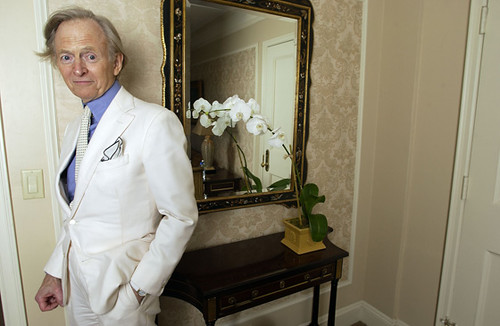
Tom Wolfe: Fiction today sucks


Noted author Tom Wolfe, on the state of fiction in an interview with Time Magazine:
"There's so little of it now that it's pathetic, and it's pathetic all over. Writers come from master of fine arts programs now. If you add up the college education of Steinbeck, Hemingway and Faulkner, you get to spring break of freshman year."
Harsh. Do you agree?

[Via Jacket Copy]

Saturday, September 13, 2008

Muderati on story structure, building a second act

Alexandra Sokoloff, writing at crime fiction blog Murderati, has been posting a series of pieces dissecting story structure and the elements of a strong, dramatic story.

She's just posted her thoughts on Act 2:

Act Two is summed up by the greats such as, like, you know, Aristotle - as “Rising Tension” or “Progressive Complications”. Or in the classic screenwriting formula: Act One is “Get the Hero Up a Tree”, and Act Two is “Throw Rocks at Him” (and for the impatient out there, like Toni, the end-skipper, I’ll reveal that Act Three is; “Get Him Down.”)

All true enough, but a tad vague for my taste.

So let’s get more specific.

The beginning of the second act of a book or film (30 minutes or thirty script pages into a film, 100 or so pages into a book) – can often be summed up as “Into the Special World” or “Crossing the Threshold”. Dorothy opening the door of her black and white house and stepping into Technicolor Oz one of the most famous and graphic examples… Alice tumbling down the rabbit hole is another. The passageway to the special world might be particularly unique… like the wardrobe in THE LION, THE WITCH AND THE WARDROBE; that between-the-numbers subway platform in the HARRY POTTER series; Alice again, going THROUGH THE LOOKING GLASS; the tornado in THE WIZARD OF OZ; the blue pill (or was it the red pill?) in THE MATRIX; or the tesseract in A WRINKLE IN TIME.

This step might come in the first act, or somewhat later in the second act, but it’s generally the end or beginning of a sequence – think of ALIEN (the landing on the planet to investigate the alien ship), STAR WARS, RAIDERS OF THE LOST ARC, going out on the ocean in that too-small boat in JAWS, flying down to Cartagena in ROMANCING THE STONE, flying to Rio in NOTORIOUS, stopping at the Bates Motel in PSYCHO. It’s often the beginning of an actual, physical journey in an action movie; in a ghost story it is entering the haunted house (or haunted anything). It’s a huge moment and deserves special weight.

Obviously, this is useful beyond the world of crime fiction, but fiction in general, in any form. Here are her thoughts on creating your first act.

And, you savvy Connelly fans will find a quick reference to our favorite anti-hero, Detective Harry Bosch, in the first section of the post, where Sokoloff responds to an email about characters changing over longer periods of time (many books vs. one). Interesting reading.

Wednesday, September 10, 2008

What are you reading?


I'm stealing an idea from Connie at The Miami Herald and asking a question via the InterGoogle that I often ask people in person: What are you reading now? And, more importantly, how is it?

I'm still tearing through Michael Connelly's library. I'm on my ninth book of his (which, I realized last night, I've read in little over a month), eight of which have been installments in the Harry Bosch detective series. The one I'm reading now, though, Chasing the Dime, isn't part of the series. It tells the story of chemist Henry Pierce, who discovers that his new phone number used to belong to someone else. That someone else being a high-priced escort named Lilly who has gone missing. Things get weirder from there, and Henry finds himself immersed in the seedy world of prostitution and Internet adult entertainment.

At first, I was a little annoyed at the book. See, it was the third book in a three-book omnibus I'd bought. Two of the books were Bosch novels, so I was really looking forward to continuing the adventures of Harry. So, I was a little irked to find this standalone story grouped with two from the series. But, after muddling through the first few chapter, I realized that not only was this a decent mystery in its own right (and also featured a number of previously seen characters from the Bosch series), but also had a few hints and tips on how I could better execute my own crime novel, which has some parallels to Dime, most visibly the notion of the non-detective becoming the hero/detective against his better judgement and out of a desire to help a friend/person in need.

In that respect, Chasing the Dime has been a helpful guide toward getting a sense of how I could make my book work, and how I could make it different and potentially avoid some of the story mistakes my radar picked up while reading the novel. I wouldn't say it's as entertaining as the Bosch books, but that's fine. That can be chalked up to familiarity with the character and the comfort zone that creates. Still, I'd consider reading another Henry Pierce novel. Assuming he doesn't end up dead -- I still have a few more chapters to go.

Friday, September 05, 2008

Crime Fiction 101

Hey all, king suckerman here. Newest addition to the very snazzy Screenwriters League blog. Many thanks to Cake Man, Zombie and the rest of the gang for the warm welcome, etc.

OK, now that the pleasantries are out of the way, let me chatter a bit about what really drives me to write: Crime. Crime fiction, mysteries, thrillers, police procedural novels, private eyes -- whatever you want to classify it as -- is the kind of fiction that gets me going, and, the kind of fiction I aspire to write revolves around crime.

Now, before you jump to conclusions and assume I just haven't read other stuff, let me assure you that I've been a fan of a bunch of different kinds of genres over time. Sci Fi, historical fiction, straight up literature (vague, I know, but there you have it) and so on. But crime, or at least crime fiction done well, is not just about the good guys winning and the bad guys being punished. Often, it's quite the opposite. No, good crime fiction paints a picture of the world we live in, and shows us not only the crimes happening, but why they happen, and how the build-up and aftershocks of the criminal act affect the doer and the victim, and those around them.

I'm in the early stages of a first draft for a crime novel -- which you can read here. I actually write directly into the blog, then paste it into a document on my computer. I find it more liberating than staring at a blank document. The blog format allows me to scroll down and see what I've worked on before, leave myself little plot reminders or character notes ("Maybe the character should DIE?") and generally works better for me. Probably different for everyone else, but here we are.

Anyway, when I decided I was going to dive into this, I knew two things: 1) Obviously, I had to finish the damn book, and later, make an effort to see it in print. Otherwise, what's the point? 2) That it would be something I'd want to read. That's the hardest part, but also the most fulfilling. If you write something you enjoy reading, chances are, at least one other person will, too.

Now, I can't speak for all fans of mystery novels or crime in general, but just because something has a private detective in it, features lots of blood and has a surprise ending does not mean I'll love it. In fact, I'm usually put off by that kind of paint-by-numbers storytelling. Surprisingly, there's a huge and hungry audience for that kind of writing. It's just not for me. The stuff that really gets me going is really less about the crime and the Oh-shit-I-can't-believe-Tito's-face-got-blasted-off moment and more about the characters and society being spotlighted in the book. I'm less inclined to wallow in the cliches of the genre ("Oh, he's a bitter ex-cop with a drinking problem and mommy issues? Sold!"). The stuff I want to read should tell me something. About location. About the people that live there. What music do they listen to? What made Character X rob that store? Why did Character Y die in a pool of her own blood just outside her apartment?

Crime is about cause and effect, less about good vs. evil. And unlike the trite saying, crime does pay -- sometimes. But never fully, and never without consequence. Sometimes the good guys don't win. Hell, they rarely win outright. Crime fiction is a way to show the unfairness of life in a clear and unfiltered way, through the extreme actions and reactions of everyday people caught up in random or calculated acts of violence and malice. A good crime book is more than just a cool car chase, sexy femme fatale or an interesting CSI trick that leads to the bad guy's apprehension -- it's about conflicted characters muddling through the gray areas of their internal worlds and the city they live in and slowly realizing that life, like any good work of fiction, isn't compact or nicely tied together. Instead, it's got loose ends, nebulous characters, frightening choices and no tidy solutions.

So, yeah. I like crime books. But enough about why I like them. Let's get into the nitty gritty. Here are, in my estimation, the five crime books that most influence my own work (sometimes too much):


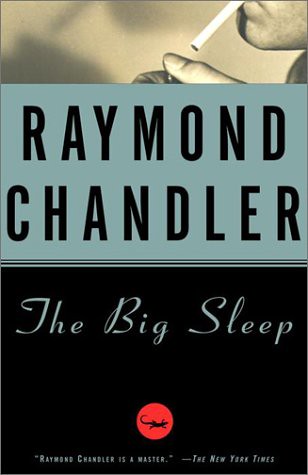
Raymond Chandler, The Big Sleep: The gold standard of P.I. fiction. Chandler's first -- and arguably best -- Philip Marlowe novel isn't so much about story -- you'll realize you have no idea what's going on at various points in the book -- as it is about style. Chandler's gritty, drunken and stumbling prose was probably cool then and even cooler now. Set the tone and many of the trappings of P.I. fiction for decades. A must-read.


George Pelecanos, A Firing Offense: If I was a more self-aware writer, I'd probably admit that I draw a lot of inspiration from this book. A lot. Moreso than the other four on the list. Nick Stefanos is a thirtysomething ad salesman for a chain of appliance stores. Nick is also a slacker, a smart-ass and a divorced drunk and social drug user. He's also a big music fan. A Firing Offense is the story of how someone trips and falls into another, more dangerous life, but a life they were always meant to lead. Riddled with musical references, wonderfully descriptive settings, akward encounters and frighteningly real action, this book is a perfect introduction to the world of Pelecanos.


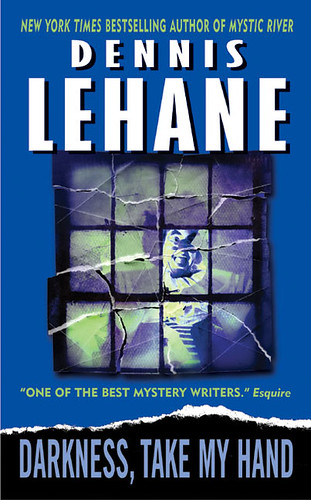
Dennis Lehane, Darkness, Take My Hand: Killer clowns by the writer of Mystic River. Need I say more? OK, I will. This is the second novel to feature Lehane's detective team of Patrick Kenzie and Angie Gennaro, two young private investigators dealing with not only their own personal demons and relationships, but the raw violence and evil lurking behind the shadows of Boston's poorest corners. If you're a quick reader, I'd say start with the first Kenzie/Gennaro book, A Drink Before The War. If you want to read the best in the series, start right here. Either way, you won't be disappointed.


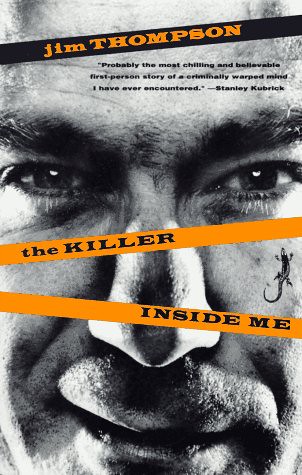
Jim Thompson, The Killer Inside Me: Lou Ford is a bore. He's the sheriff of a podunk town full of bland, cookie cutter citizens. At least, that's what it looks like to everyone else. But in reality, Lou Ford is a sociopathic killer. The slow and creepy unraveling of Lou's true persona is doubly disturbing because the book is told in the first person, and the unreliable narrator is certainly that. As the story progresses, the reader discovers the true Lou: cunning, murderous and morally vacant. One of the most disquieting books I've ever read.


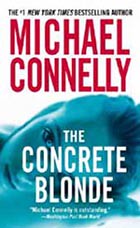
Michael Connelly, The Concrete Blonde: Four years ago, Hollywood Detective Harry Bosch came across the serial killer known as the Dollmaker. In what was later deemed a righteous kill by his department, Bosch took down the killer as the suspect reached for what appeared to be his weapon. Bosch, always a police maverick, was demoted but also seen as a hero by many. Now, Bosch is facing a civil trial -- the Dollmaker's family is charging that the detective acted out of poor judgement and should be held responsible for the accused Dollmaker's death. If that wasn't enough, it looks like another Dollmaker victim has popped up -- except, this murder happened after Bosch killed the guy he thought was the killer. Connelly's third Harry Bosch book elevates the series from good to great, as the former crime reporter explores not only Bosch's fractured and conflicted psyche, but litters the stage with a number of potential killers and avenues of explanation. Definitely a puzzle in prose form, but with more heart than you'd expect.

Anyway, I'm happy to be here. Hope you guys enjoy SILENT CITY as it moves along, and my contributions to this space.