I have to admit, while Basket Case was enjoyable, it lost a little steam toward the end. As I noted last time, the plot of the book appealed to me because the book was set in South Florida and also because the lead character was a journalist. Hiaasen did a great job of painting a newspaper scene, and I really learned a lot from reading the book in that regard. Unfortunately, while his scene-setting when it came to SoFla was decent, it didn't really make me feel like I was back home (I'm from FL, FYI), and a lot of the names used seemed fake and/or forced, which is exactly the opposite of what I'm trying to do with my book. Overall, the plot resolved itself too easily and neatly. I won't spoil the final plot twist, but it left me wanting. Additionally, the "unexpected" romance between protagonist Jack Tagger and his editor Emma came off as unnatural and predictable. Emma's initially painted as a nervous, antsy and neurotic shrew -- so why is the rebellious and cantankerous Jack suddenly drawn to her? Why does she kiss him randomly? It didn't feel right. Understandably, building a functional romantic dynamic is hard, especially when the characters start off as opposing forces. But there didn't seem to be enough time spent on the "Moonlighting"-style moments, where the two opposing characters are at each other's throats but still flirting somewhat. Overall, the book is what it set out to be: a breezy read for someone looking for something entertaining and slight between serious books.
Once I finished Basket Case, though, I was a little desperate. My to-read pile had dwindled to a stack of Ellroy books (more on that later) and Ross MacDonald's The Way Some People Die. The latter was given to me by a friend that works in publishing, but I'd read very little about MacDonald or any of his work. Well, I was pleasantly surprised.
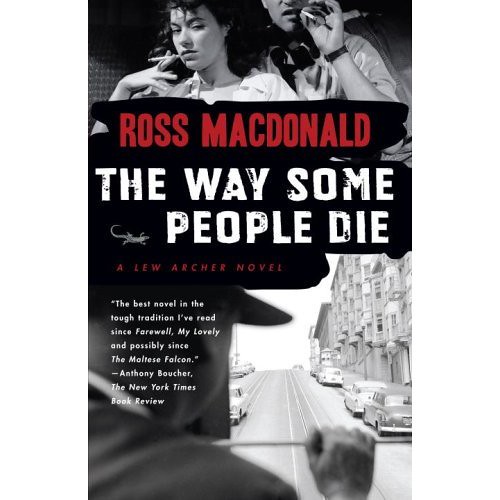
I've gone on and on about my favorite contemporary crime authors -- Pelecanos, Lehane, Connelly, etc. But I've said little about my favorite old school, first generation crime writers. Obviously, Raymond Chandler is atop that list. For a long time after reading his entire output (gold stars next to Farewell, My Lovely, The Big Sleep and The Long Goodbye), I was left wondering if there was a true and proper heir to the colorful, stylized and just plain cool detective novels Chandler created, starring the archetypal gumshoe, Philip Marlowe. For a time, I thought Michael Connelly was the guy, but after a few Bosch books (great as they were), I realized that Connelly was more about a tight, forceful plot and less about the atmospheric and literary strengths that Chandler reveals in his work. Well, Ross MacDonald is it.
Like Chandler, MacDonald chronicles the adventures of a sharp, do-right PI. In MacDonald's case, the guy's name is Lew Archer. Like Marlowe, Archer is a strong believer in right and wrong and finds himself in sticky situations that involve subterfuge, mistaken identities and murder. In The Way Some People Die, Archer is for all intents and purposes a Marlowe clone. But that's fine. And based on what little I've read about the series, I know he eventually evolves into something else. But for someone who was craving more Chandler, MacDonald provides the perfect fix.
While Chandler's work is more about painting a scene and colorful language, MacDonald is also equally about plot. So -- in crude terms -- not only does it read like something cool and interesting is going on, but you also can follow the story and understand who the characters are, a flaw I found in most of Chandler's work, but one I was willing to overlook because the ride was so much fun.
The Way Some People Die starts simply enough -- an aging mother begs detective Lew Archer to find her lovely twentysomething daughter Galatea (otherwise known as Galley), who hasn't been in touch for over two months. What follows is a tale of drug-smuggling, prostitution, murder and multiple double-crosses. It reads like a great, old movie, with the requisite femme fatale, gangster villains and surprising turncoats. If you like mysteries, this is a keeper.
Additionally, like most of Chandler's work, The Way Some People Die is a relatively quick read, clocking in at a little over 270 pages (coincidentally, right around where I'd like SILENT CITY to land, when I finish it. I managed to talk my friend to toss a few more MacDonald books my way, so I wouldn't be surprised to see me writing about him a lot more in this here space. Well, unless I go on an Ellroy tear.
Which is highly likely.
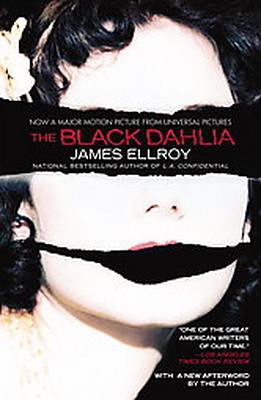
I've had an interesting relationship with the works of James Ellroy. I've always been a fan. My Dark Places (nonfiction) and Ellroy's Lloyd Hopkins trilogy of detective novels are books I think of often and remember really enjoying when I read them. But for whatever reason, I could never bring myself to dive into his more lauded work, namely the "L.A. Quartet" of books, which consist of The Black Dahlia, The Big Nowhere, L.A. Confidential and White Jazz. I tried reading Dahlia a few years back and stalled about 20 pages in. I'm a big believer that if you can't get past the first 20-30 pages of a book, if you're not driven to keep reading it, you're better off just putting it down for a while and moving on to something else. The spark might just not be there. Recently, having finished The Way Some People Die and without another MacDonald book, I picked up Dahlia again. Why Dahlia, specifically? Well, I needed the material to be redeemed in some way. The Brian De Palma-directed movie based on the book was horrible, and I needed to wash that taste out of my mouth. Additionally, Dahlia kicks off the previously mentioned Quartet, so it seemed like as good a place as any to dive into Ellroy.
Great decision. Ellroy is in top form with Dahlia, shrugging off the slight awkwardness and stiff pacing of his earlier novels to create a book that is true neo-noir. As most should know, the book is a fictionalized account of the real Black Dahlia murder. I'm barely 100 pages in, but I've already reached that point where you can't put the book down and all you want to do is curl up and read until you're done. And then, ideally, have another book at the ready. I'll have more concrete thoughts on the book in the next installment, I'm sure, but suffice to say, Dahlia is a pleasure to read. I almost want to kick myself for not plowing through it years ago. It also made me want to "fix" the movie, so expect a post later this week which features me re-casting the entire thing. If I find the time, of course.
Enough about me, though. What are you reading?