Showing posts with label novels. Show all posts

Friday, October 24, 2008

What are you reading? Week 5: Back on the crime fiction beat

Last week, we bid adieu to our friends Nick and Norah and took a tentative step back into crime fiction with the "comedic crime" of Carl Hiaasen. Specifically, his newspaper caper book, Basket Case.

I have to admit, while Basket Case was enjoyable, it lost a little steam toward the end. As I noted last time, the plot of the book appealed to me because the book was set in South Florida and also because the lead character was a journalist. Hiaasen did a great job of painting a newspaper scene, and I really learned a lot from reading the book in that regard. Unfortunately, while his scene-setting when it came to SoFla was decent, it didn't really make me feel like I was back home (I'm from FL, FYI), and a lot of the names used seemed fake and/or forced, which is exactly the opposite of what I'm trying to do with my book. Overall, the plot resolved itself too easily and neatly. I won't spoil the final plot twist, but it left me wanting. Additionally, the "unexpected" romance between protagonist Jack Tagger and his editor Emma came off as unnatural and predictable. Emma's initially painted as a nervous, antsy and neurotic shrew -- so why is the rebellious and cantankerous Jack suddenly drawn to her? Why does she kiss him randomly? It didn't feel right. Understandably, building a functional romantic dynamic is hard, especially when the characters start off as opposing forces. But there didn't seem to be enough time spent on the "Moonlighting"-style moments, where the two opposing characters are at each other's throats but still flirting somewhat. Overall, the book is what it set out to be: a breezy read for someone looking for something entertaining and slight between serious books.

Once I finished Basket Case, though, I was a little desperate. My to-read pile had dwindled to a stack of Ellroy books (more on that later) and Ross MacDonald's The Way Some People Die. The latter was given to me by a friend that works in publishing, but I'd read very little about MacDonald or any of his work. Well, I was pleasantly surprised.
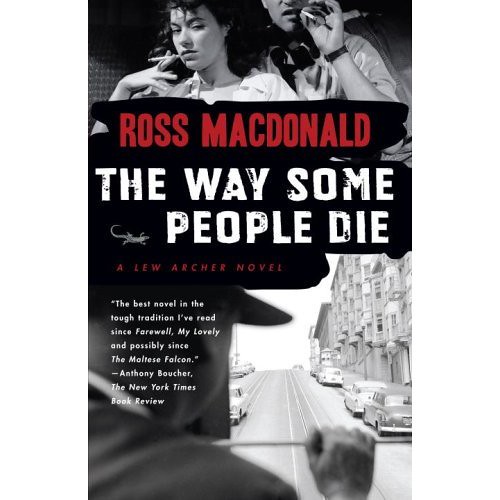


I've gone on and on about my favorite contemporary crime authors -- Pelecanos, Lehane, Connelly, etc. But I've said little about my favorite old school, first generation crime writers. Obviously, Raymond Chandler is atop that list. For a long time after reading his entire output (gold stars next to Farewell, My Lovely, The Big Sleep and The Long Goodbye), I was left wondering if there was a true and proper heir to the colorful, stylized and just plain cool detective novels Chandler created, starring the archetypal gumshoe, Philip Marlowe. For a time, I thought Michael Connelly was the guy, but after a few Bosch books (great as they were), I realized that Connelly was more about a tight, forceful plot and less about the atmospheric and literary strengths that Chandler reveals in his work. Well, Ross MacDonald is it.

Like Chandler, MacDonald chronicles the adventures of a sharp, do-right PI. In MacDonald's case, the guy's name is Lew Archer. Like Marlowe, Archer is a strong believer in right and wrong and finds himself in sticky situations that involve subterfuge, mistaken identities and murder. In The Way Some People Die, Archer is for all intents and purposes a Marlowe clone. But that's fine. And based on what little I've read about the series, I know he eventually evolves into something else. But for someone who was craving more Chandler, MacDonald provides the perfect fix.

While Chandler's work is more about painting a scene and colorful language, MacDonald is also equally about plot. So -- in crude terms -- not only does it read like something cool and interesting is going on, but you also can follow the story and understand who the characters are, a flaw I found in most of Chandler's work, but one I was willing to overlook because the ride was so much fun.

The Way Some People Die starts simply enough -- an aging mother begs detective Lew Archer to find her lovely twentysomething daughter Galatea (otherwise known as Galley), who hasn't been in touch for over two months. What follows is a tale of drug-smuggling, prostitution, murder and multiple double-crosses. It reads like a great, old movie, with the requisite femme fatale, gangster villains and surprising turncoats. If you like mysteries, this is a keeper.

Additionally, like most of Chandler's work, The Way Some People Die is a relatively quick read, clocking in at a little over 270 pages (coincidentally, right around where I'd like SILENT CITY to land, when I finish it. I managed to talk my friend to toss a few more MacDonald books my way, so I wouldn't be surprised to see me writing about him a lot more in this here space. Well, unless I go on an Ellroy tear.


Which is highly likely.

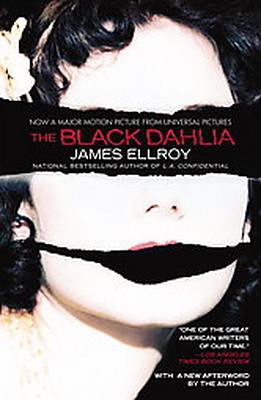
I've had an interesting relationship with the works of James Ellroy. I've always been a fan. My Dark Places (nonfiction) and Ellroy's Lloyd Hopkins trilogy of detective novels are books I think of often and remember really enjoying when I read them. But for whatever reason, I could never bring myself to dive into his more lauded work, namely the "L.A. Quartet" of books, which consist of The Black Dahlia, The Big Nowhere, L.A. Confidential and White Jazz. I tried reading Dahlia a few years back and stalled about 20 pages in. I'm a big believer that if you can't get past the first 20-30 pages of a book, if you're not driven to keep reading it, you're better off just putting it down for a while and moving on to something else. The spark might just not be there. Recently, having finished The Way Some People Die and without another MacDonald book, I picked up Dahlia again. Why Dahlia, specifically? Well, I needed the material to be redeemed in some way. The Brian De Palma-directed movie based on the book was horrible, and I needed to wash that taste out of my mouth. Additionally, Dahlia kicks off the previously mentioned Quartet, so it seemed like as good a place as any to dive into Ellroy.

Great decision. Ellroy is in top form with Dahlia, shrugging off the slight awkwardness and stiff pacing of his earlier novels to create a book that is true neo-noir. As most should know, the book is a fictionalized account of the real Black Dahlia murder. I'm barely 100 pages in, but I've already reached that point where you can't put the book down and all you want to do is curl up and read until you're done. And then, ideally, have another book at the ready. I'll have more concrete thoughts on the book in the next installment, I'm sure, but suffice to say, Dahlia is a pleasure to read. I almost want to kick myself for not plowing through it years ago. It also made me want to "fix" the movie, so expect a post later this week which features me re-casting the entire thing. If I find the time, of course.

Enough about me, though. What are you reading?

Wednesday, October 08, 2008

Are publishers asking novelists to dumb their work down? Yeesh. Hope not.

The Independent seems to think so:

Margaret Drabble, one of Britain's leading novelists and biographers, believes her publishers are pushing her to "dumb down" her work to appeal to a larger readership.

At a meeting of alumni in her old Cambridge University college, Newnham, Dame Margaret suggested that she felt pressure from Penguin, to "rebrand" her fiction, The Independent has been told. At the discussion, alongside the novelist Sarah Dunant, she said: "I have had a weird feeling that I'm being dumbed down by my publishers and it's interesting there's an agenda of how it should be in the marketplace."

Dame Margaret, 69, who takes over as chair of The Society of Authors, added: "I'm amazed they are even trying it on."

Few would doubt Dame Margaret's position in today's literary firmament. In a career spanning more than 40 years, she has written 17 novels and seven works of non-fiction as well as earning a CBE. Dame Margaret, who turned up to discuss the state of literary culture with Ms Dunant, revealed to Ms Dunant she had had a tense conversation with her publishers: "She [Dame Margaret] ... expressed the view that her publishers wanted to remarket her in some way, that there was some need not to let the work just stand on its own.

"My impression... was that there was a certain amount of trepidation in putting this to her (from her publishers). She had given them short shrift. She felt that at this moment in [one's] career, who could need to be remarketed or repackaged?" Ms Dunant said. Ms Dunant said Ms Drabble was annoyed that publishing houses to market authors as "semi-celebrities."

It's an interesting question. When does marketing stop helping a book and begin to alter the perception of what the book is? I'm not sure. I think it's case-by-case. Obviously, if an author, like Drabble, has a long and storied career and is doing just fine with a solid base of readers, over-marketing won't do much. It'd be like expecting the new Stephen King or John Grisham book to sell like crazy because of a different way of pitching the authors. These guys are known commodities.

Now, when it comes to a new author, I think the initial marketing plan is key. How do you position this writer? Do you expect them to be the kind of author that will need two or three books before they really cement themselves and build a readership? Or is the first book such a homerun that you should go all out the moment you step out of the gate? Again, it depends a lot on the author and, more importantly, the material. I'm not 100 percent sold that this article is on the money, since there are so many variables. What do you think? How does marketing affect what you buy at the bookstore?

[Via Bookninja]

Tuesday, October 07, 2008

What's in a name? A lot, actually

What are some of the worst novel titles ever? The New York Times Paper Cuts blog asks, citing Neal Stephenson's latest work as an example of a not-so-great one:

The title of Neal Stephenson’s latest work of speculative fiction, “Anathem,” struck me as an unfortunate one, at least on first (and second) glance, for three reasons: it looks like a typo for “Anthem”; we can’t be entirely sure how to pronounce it; and most of us have no idea what it means. Still, it’s better than “Religulous” or “A Bold Fresh Piece of Humanity.”

Stephenson’s novel (which we will be reviewing in a future issue) takes place in a world much like our own. Before reaching the contents page, the “note to the reader” and the chronology, we get this dictionary definition:

Anathem: (1) In Proto-Orth, a poetic or musical invocation of Our Mother Hylaea, which since the time of Adrakhones has been the climax of the daily liturgy (hence the Fluccish word Anthem meaning a song of great emotional resonance, esp. one that inspires listeners to sing along). Note: this sense is archaic, and used only in a ritual context where it is unlikely to be confused with the much more commonly used sense 2. (2) In New Orth, an aut by which an incorrigible fraa or suur is ejected from the math and his or her work sequestered (hence the Fluccish word Anathema meaning intolerable statements or ideas). See “Throwback.”

Titles are tricky. You have to on one hand say something about what your book is, well, about, but also have something that will resonate with both the casual reader scanning the shelf and the literati crowd some/most of us are trying to appeal to.

With SILENT CITY, I was trying to strike a noir-ish note while still having the title in some way connect to the story (a plot point I'm still trying to flesh out to some degree -- why is Miami, of all cities "silent"? Read on, read on...). It's something I'd imagine most writers mull over and pull hairs out in frustration.

I've found that the best titles are directly from the page -- either an offhand remark or a descriptive line or two. That usually works for me, even with poetry or songs. But it's still a challenge.

Do you, as a writer, have a process for coming up with a title? Do you wait until the end, or have some kind of method? What are some of the worst book/movie/album titles ever? Discuss.

Monday, October 06, 2008

How does this stuff get published?

Every year, the Bulwer-Lytton Awards recognize horrible first sentences in novels. Over at io9, the sci-fi blog points out that the winner sounds strangely similar to another, painfully bad first sentence. You decide:

Joe Schulman won the Bulwer-Lytton in science fiction for this stinker:

Timothy Hanson, Commander of the 43rd Space Regiment in the 52nd Battalion on board the USAOPAC (United Space Alliance Of Planets Attack Carrier) and second in command to Admiral L. R. Morris of the USAOP Space Command, awoke early for breakfast.

Meanwhile, David Sherman & Dan Cragg's novel Starfist: Wings of Hell, forthcoming from Del Rey in December, begins with this line:

Captain Lew Conorado, the commander of Company L of the infantry battalion of Thirty-fourth Fleet Initial Strike Team, settled into the chair behind the desk in his office and sighed.
I don't know about you guys, but I'd definitely read something titled Starfist: Wings of Hell. How could you not?

Thursday, September 25, 2008

Go ahead, judge a book by its cover. Please.


This is pretty neat:
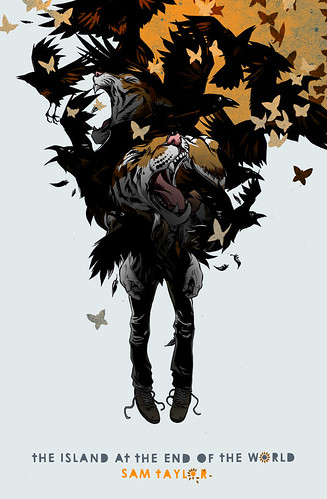
As part the first year of Hearts & Minds, Creativity partnered with Penguin Books on a talent contest, asking artists of all types to conceive a cover design for one of the publisher's upcoming titles. Penguin, as you may know, appeared in our Creative Marketers report last year, for bringing an updated art-driven aesthetic to its book covers. Notably, its Graphic Classics have become veritable collectors items, with cover art reimagined by contemporary artists like Frank Miller, Tomer Hanuka, Roz Chast and Art Spiegelman.

Penguin and Sam Taylor, author of The Amnesiac, kindly offered up Taylor's upcoming novel The Island at the End of the World as the foundation of our competition. Designers, illustrators, painters and photographers contributed more than 300 ideas for the cover design of Taylor's new book, and a jury comprised of Penguin editor Alexis Washam, creative director Paul Buckley and Creativity editors selected the 25 finalists presented here.
Click here to view the other 24 finalists. I've posted my favorite up top.

Also, here's an item about the best covers of 2007, from The New York Times.

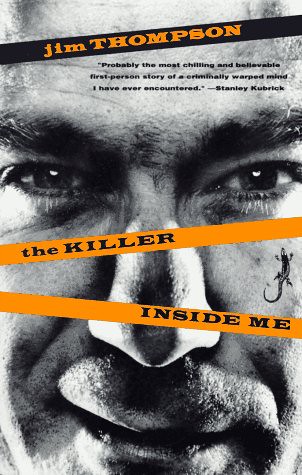
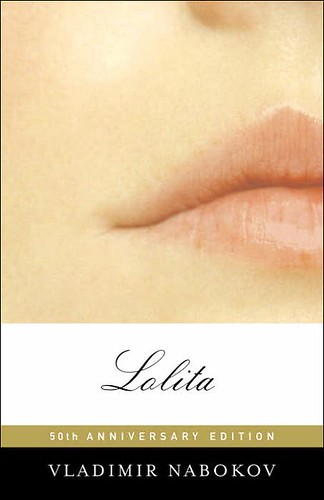
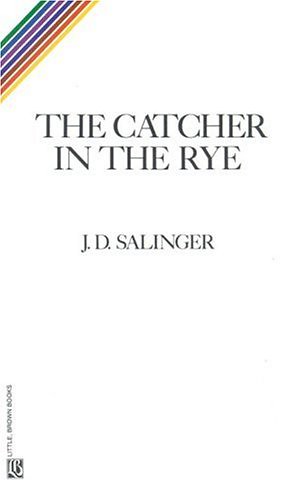
And just to personalize things a tad, here are a few of my favorite book covers, off the top of my head:


What are some of your favorite book covers? What makes them great? Feel free to include links to the images.

[Via Galleycat]

Wednesday, September 10, 2008

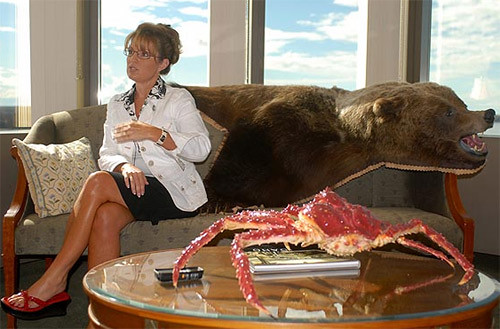
Sarah Palin: A novelist's view


The L.A. Times book blog, JACKET COPY considers VP candidate Sarah Palin as a character. Worth reading:

As a novelist, I am fascinated by the emergence of Sarah Palin as a character. This lively cross between Annie Oakley and Eva Braun seems to have released Republican chakras to a degree that could be matched only by the resurrection of Ronald Reagan. This is more extraordinary by virtue of her having been an unknown local politician until — what? oh, about five minutes ago. As the nation slouches toward her possible elevation to the second-highest office in the land, we're all taking a closer look at what's gone on in Alaska these past few years.

There's the aerial wolf hunting, the moose burgers, the book banning — excuse me? The book banning? As Jacket Copy reported earlier this week, Palin leaned on the local librarian when she was mayor of Wasilla, urging her to ban certain texts. In other words, we are in danger of going from a nation where the first lady is a former librarian to one where the vice president is a character in "Fahrenheit 451." Clearly, this is what they mean by change you can believe in.