Tuesday, October 14, 2008

Writing groups -- they can be good for you


So your manuscript is done. Everyone (and by everyone, I mean, your friends and family) seems to like it. But after you make some calls and send some letters, all you're getting is crickets and tumbleweeds. Could your writing not be as good as Hemingway, as you first thought?

Murderati breaks it down. You may want to consider joining a writing group. Like any grouping of people, writers groups come with pros and cons. Here's what Murderati says makes for a good group:
1. Rules
This isn't a social hour, it's a work session. The group I belong to follows the basic guidelines set up by Clarion. You can read two good articles on this here (how to workshop) and here (insights into how to react when being critiqued).
2. Trust
Participants need to feel that everyone in the group has the same goal when they're reading and critiquing: to help each other write and tell the best stories possible. That's it.
Do I need to mention NO STEALING? I sure hope not.
3. Commitment
Participants have to be willing to read the good and the bad, and to treat each submission -- and each member -- with utter respect. No showing up without having read the submissions, no comments without considered rationale.
4. Confidentiality
Only gab or complain about participants in the group IN the group -- and rarely do that, if ever. Keep mum about other people's works-in-progress.
5. Similar levels of writing experience
It's uncomfortable and inappropriate to have writers with vastly different levels of experience in the same group. If you do, some participants become "experts" while others are peons. How can you possibly nourish the useful kind of democracy that promotes honest communication in that case? I don't think it can happen.
Meanwhile, PoeWar has a list of things you can do that will most definitely annoy fellow group members. A smattering:

10 Ways to Annoy the Hell out of your Writers’ Group

  • Attend sporadically. Most writers’ groups have rules about attendance, but once you are there, what are they going to do? Do they seriously have the stones to kick you out? I think not. Writers are usually nice people — exploit that.
  • Bring the whole novel. Most writers’ groups try to keep the length of the things they are discussing to a reasonable level. After all, most members have jobs or kids or classes. Some members even want to spend time on their own writing. They can’t be expected to read and critique hundred of pages a week… or can they? After all, the main reason the group exists is to serve your needs.
  • Don’t worry about the genre. The science fiction writer’s group is the perfect place to present your nihilistic seventies romance. If anyone makes a fuss, tell them that they’re stifling you.
  • Don’t waste a lot of time reading the other member’s work. Try to limit any review to the five minutes before the group meets. Make a show of marking up the paper with red lines or a highlighter. Just pick random passages to mark. There’s always something wrong with everything if you look hard enough.
  • Keep an eye out for typos or spelling errors. Some writers think that a writers’ group should focus on character, plot, themes and other esoteric things. Stick to the basics. If you find a spelling error or a grammar error, focus solely on that. Make sure the discussion lasts twenty minutes at least. By discussion I mean you prattling on, interrupting other people whenever they try to take part.
  • Keep other criticisms as vague as possible. Look for statements that sound intelligent but mean nothing. String them together for as long as you can. Sample Rant: You need this story to feel more real. It doesn’t speak to me yet. When I read it, it feels like a story. It’s as if someone wrote it down and expected me to read it and come away with some sort of impression. I shouldn’t have to know so much about the characters in order to get them. They should be a part of the page. The whole thing should function holistically and organically.
I know Cake Man touched on this before, way back in the pre-suckerman days, so I'll toss in my two cents. I find that being in a writers' group to be a great motivator. Knowing that I have a meeting coming up and should crank out some pages really helps me get in front of my computer and WRITE. Which is a good thing.

The tricky thing for me is, since I'm writing a novel, I'm going to have a lot more pages to present before I'm "finished." Pretty much everyone else is working on a specific screenplay, which probably won't clock in over 200 pages. But that's overly technical and something that is easily resolved. I find the feedback you get in the group to be very helpful. Obviously, like anything else, you have to parse through the notes and suggestions and decide "is this helpful?" Your initial instinct when dealing with harsh commentary is to toss it and chalk it up to the person not "understanding" what you're trying to do. But once you do that, you might as well stop coming to the meetings. The best part of a writers group is that you're getting an initial, ideally unfiltered reaction from a wide spectrum of readers. This is what you want. You want to see how Joe Regular Reader reacts to your material. Will they keep reading? What made them stop reading? Those are the things that are really invaluable.

Yeah, I'll read that.


Guess who's writing a memoir?

Alive and kicking from New York, it's Tina Fey's book deal!

Amid reports of particularly egregious bidding wars, Fey's rep has confirmed the Saturday Night Live cum 30 Rock cum Saturday Night Live star has continued in her quest for media domination and indeed signed a book deal.

Details are being kept under wraps, with no official word on subject matter, release date or the value of Fey's contract.

What has been confirmed is that Little, Brown & Company will release the would-be best-seller.

Last week both the New York Post and Observer reported that Fey was entertaining offers in the $5-6 million range and that the tome would not be a memoir, but "nonfiction humor," most likely a collection of humorous essays.

While Team Fey and her publisher are mum on the money, reps for both did confirm that the deal included a gift to the nonprofit group Books for Kids to help stock school libraries in New York City.

I'm not an avid viewer, but I've enjoyed the episodes I've caught here or there. It looks like Sarah Palin did some good...for someone.

Thoughts from a literary agent: Query Letter Don'ts

There are a few things Janet Reid doesn't want to see in your query letter:
1. Theme

I don't care what the theme of your work is. I care what the story is.

2. I love to write

I don't care. I only care about whether you can write well enough to tell a good compelling story.

3. I think my book will make a great movie.

I don't care. I only care whether it will make a good book.

4. It took me x+1 years to write.

I don't care. I only care if it's a good story.

Pretty basic stuff, I think.

Reid's blog is worth bookmarking. Also worth checking out: posts about things that annoy Reid, and her collection of query letter pitfalls.

Monday, October 13, 2008

The Writing Week part 41 -- CONTINUOUS!


In re-reading my comic book/action spec, I started finding little things that annoyed me within my writing, small things that, one their own and irregular, would pose no real problem. Taken together and done frequently, though, they could be quite problematic. Thus, I think it’s time to add two more villains to the League’s Rogues Gallery - Exclamation Point (!) and CONTINUOUS (with his sidekick, MOMENTS LATER).

Exclamation Point, CONTINUOUS, and MOMENTS LATER aren’t enormous problems, but they can provide quite formidable when they join forces in a script. (As point of reference, think of them not as the end-of-the-game boss in a 2-D screen-crawler fighter game circa 1995, but as an end-of-level boss. Once you learn their mannerisms and can time their attacks, you can take them down no problem.)

My worries with exclamation points resurfaced at an NYC Screenwriters Meetup last week
. In preparation for the meeting, we had to read a script written by one of the Meetup members, and at the meeting, we all gave feedback. I won’t go into the script here, other than to say that it contained exclamation points! A lot of them! Almost every other line of dialogue had them! YAY!

They got pretty distracting. So, in re-reading my comic book spec this week (and my post-Apocalyptic one last night), I was on the lookout for those dreaded little buggers. I’ll admit, I had more of them in the dialogue than I would have thought. Of course, I tried to rationalize that, these being action scripts, they could allow for a lot of exclamation points. Even I didn’t buy that all the time. I wound up cutting most of them, but it brings up an interesting point. Have you heard of any rules for when to use exclamation points? When do you use them?

Next, I had to tackle CONTINUOUS and the ever meddling MOMENTS LATER. These guys (or gals) can be a real problem. I can’t remember where, but I recently heard someone say that a writer should hardly ever try to use continuous as all action is inherently so, and putting that in the slugg line is redundant. I tend to agree, but the habit I picked up in school of having to include some time after the location for each slugg line is a hard one to break. moments later can serve a purpose, but can almost always be cut just as easily as continuous, I believe. I found I was using those phrases when cutting between multiple scenes all obviously taking place at the same time. My first reaction was to swap them out for SIMULTANEOUS, an egregious error I soon remedied.
The conclusion I came to was that using CONTINUOUS and MOMENTS LATER, just like the dreaded Exclamation Point (!) can be unnecessary and, when done too often, make a script look amateurish. Don’t rely on keywords or punctuation to strike a chord or let the reader know what’s happening. Effective dialogue and concise, descriptive action should do this on its own.

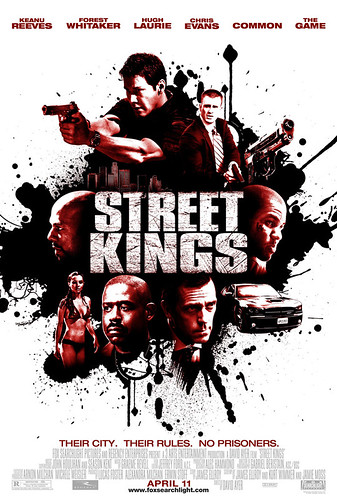
SuckerFlix: Street Kings


In addition to reading a ton, I try to watch a lot of movies, too. Not remarkably unique, I know. But I figured it'd be fun to irregularly review those films I do see (thanks, NetFlix!) here on this blog. First up is Street Kings, starring Mr. Monotone himself, Keanu Reeves.

OK, the first thing you're probably asking is "Why the hell did you even put this on your NetFlix queue?" One reason: The screenplay was written by crime fiction legend James Ellroy. One of my personal favorites. His cinematic track record is a bit spotty, both as far as the adaptations of his novels go and his own, albeit limited forays into writing for the screen himself. Still, it was enough of a reason to check it out. I'm also a big fan of Forest Whitaker and find Keanu to be generally tolerable. He's not the best actor by any means, but I have to respect him for at least being eclectic when it comes to selecting roles.

Street Kings is the story of LA vice detective Tom Ludlow, an alcoholic widower who shoots first and fills out reports later. As his boss gets lauded and promoted, Ludlow discovers that his old partner, who is also under investigation by Internal Affairs, might be ratting him out. When his ex-partner turns up dead under mysterious circumstances, Ludlow is the target of the investigation -- but also the only person able to find the real killers.

The movie is fairly paint-by-numbers. Reeves' character is borderline cliche and he does little to add to the role that would make him stand out. Whitaker, who is usually pretty magnetic on screen, comes off flat and hammy. Every time his corrupt sergeant is on, the scenery-chewing doubles.

Not surprisingly, Reeves/Ludlow stumbles upon some details that lead him to (gasp) suspect his own people of orchestrating the death of his partner, and it inevitably points back to the LAPD. I guess I should put up a spoiler warning, but the details in the first few scenes of the film point to this so loudly it's no surprise when the plot actually meanders toward the revelation. None of the secondary characters are memorable, and if anything, some are grating, like Jay Mohr's irrelevant and smarmy corrupt detective. The highlight of the film is Hugh Laurie, who has made a name for himself on FOX's House. I've never watched the show, so I was impressed at how magnetic he was on camera, and found myself wishing he was the lead instead of the fairly wooden Reeves.

Still, the movie rolls along at a brisk pace. While painfully predictable and unremarkable, Street Kings falls into the "I'm just laying around the house on a Saturday morning and want to watch something" category. Not bad by any means, but not something you'd ever make a point of watching.

Ellroy peppers the script with many of the things that stand out in his early novels: corruption in the LAPD, racial tensions and a bleak, fatalistic look at modern society. Sadly, director David Ayer chooses to focus more on the MTV aspect, with cameos from rap stars Common and The Game thrown in to make the film more palatable to the hip hop crowd, and video game-style violence that while "cool" in the moment really detracts from the plot. I found myself wondering midway through the film how Ludlow has even managed to stay alive this long. The action becomes unrealistic and distracting. The camera work is also jerky and inconsistent, as if the viewer can't decipher which scenes are supposed to be violent, so the director has to scream to let them know.

Not surprisingly, Ayer also directed Training Day, which this movie echoes in many ways. I only realized this after checking the director's credits online, but saw many similarities while watching Kings. The newer film, though, really only comes off as a watered down version of Training Day, which was still riddled with flaws but had more momentum than this. If you're a fan of cops and robbers movies and don't find Reeves too brutal to watch, then there are worse ways to spend a few hours. Otherwise, I'd pass.

SuckerFlix Grade: C+
What's next: Sidney Lumet's Before The Devil Knows You're Dead

Sunday, October 12, 2008

Worst writing advice ever?

Literary agent Nathan Bransford asks an important question: What's the worst writing advice you've ever gotten?

Some of the highlights, from the comments section:
• Remove all your commas. Editors don't like commas and they pull the reader out of the story.
• If it's not coming easily, put it down. You aren't meant to write if you have to try.
• From a creative writing teacher at my first college: "I get one like you in every class. You're a promising writer, but you're wasting your time on genre fiction that'll never be worth anything."
• "War and Peace - now that's a good book. Why don't you write a book like that?"
• "The first page of your novel MUST include the protagonist's sex, age, physical description, and location. Preferably, this is all revealed in the first paragraph."
• Beginners shouldn't start out writing novels.
• Genre fiction is on it's way out, and stories with twist endings won't sell.

I'm not surprised at most of these. I've gotten my fair share of crappy advice. I think one of the challenges of interacting with people during the writing process is that you need to learn to filter the notes and feedback you get. It's something the Leaguers discuss with regularity. Only you really know what you want to accomplish with your work, and only you can decide which pieces of advice will really help move your work forward. You have to also realize that the people reading your work don't have the notes, background info and/or mental cues that you've created while working on your screenplay/story/novel. That's a plus and minus. The plus is, they're looking at it as a normal reader would, so their reaction is much more natural and in tune with how Joe Reader would react when picking up your book off the shelf. The minus is, since the book isn't finished, they're going to have questions about where it's going or what certain things mean. Questions you've probably already answered internally. Still, overall, the good outweighs the bad, as long as your confident in your peers.

One of the biggest benefits of the League, I've found, is that we're a group of competent writers all coming from different directions. So, when I bring something up for comments, I'm getting a wide array of feedback from six very different people. If you believe in the skills of the people you're handing your work to, then you've cut down on the advice filtering process.

What's the worst writing advice you've ever gotten? The best?

[Via Jacket Copy]

Saturday, October 11, 2008

Trailer Trash XV: Terror Train (1980)


"All aboard... if you dare!"

Terror Train: The first feature film about the horrors of taking the G from Queens to Brooklyn. (Ba-dum-ching! I'm here all night, guys.)

This movie was part of the flood of Jamie Lee Curtis slashers that came out in the wake of Halloween. It's actually better than Prom Night, but that doesn't say much. The setup is your standard "college kids picked off one-by-one at a party" but it was the setting that was pretty unique. It's pretty similar to past Trailer Trash subject Hell Night in this respect - even down to the zany costumes.

The director, Roger Spottiswode, went on to bigger and better things, notably directing the Bond film Tomorrow Never Dies. The screenwriter, unfortunately, looks to have dropped out of the Hollywood scene shortly after this movie.


At 0:05 - Oh, oh no... What's behind that door!?
At 0:10 - The anticipation is killing me... I can't look...
At 0:18 - Could that be what I think it is??!?
At 0:25 - It's a TRAIN!!!! (After half a minute of slow burn, yes, it's only a train.)
At 0:38 - Ohhhhhhhhhh, I get it now. It was a terror train. Got it.
At 0:49 - It's Don Rickles!
At 0:56 - Waking up to being groped by a lizard will probably make her think twice about sleeping on a train again.
At 1:06 - "Nice gag, Don!"
At 1:23 - NO! NOT KETCHUP! ANYTHING BUT THAT!
At 1:34 - Okay, who invited the gimp?
At 1:42 - Whine, whine, whine.
At 1:55 - Bad Einstein!
At 2:35 - Don't trains 'whistle'? I've never mistaken one for a scream.

That magician you get a brief glimpse of in the trailer? It's David Copperfield.

Take a close look at this poster. Do you think that the murderer might be Gene Shalit?


Do you think this movie wasn't bad enough the first time?? Then I've got good news for you! There are not one, but TWO remakes coming for this slop pile: details here and here.

"They should have never taken... the train."