Saturday, November 01, 2008

Trailer Trash XVIII: Daughter of Dr. Jekyll (1957)


"If you love me, please do me!"

Did you know Dr. Jekyll had a daughter? And that she was a vampire? That doesn't make sense to you? Me neither! Here's the trailer:


At 0:13 - I understand that's probably pretty hard for her to find out on the eve of her marriage, but imagine how terrible that is for her fiance!
At 0:35 - His teeth are the scariest thing in the movie so far.
At 0:43 - Whaaaa...? It's been a long time since 9th grade English class, so someone back me up here - Dr. Jekyll wasn't a vampire, was he...?
At 0:47 - "Drawing sustenance from beastiality" WTF? More on this soon.
At 1:00 - Ok, stake through heart. Wikipedia doesn't say Jekyll was a vampire, so that stands.
At 1:10 - Um, that's what she said.
At 1:26 - Dream sequence courtesy of the Merry Pranksters.

Regarding beastiality: What the hell? Did this mean something else in the 1950s? Y'know, like in the 1950s when boner didn't mean, y'know, boner?


Ohhhhh, bestial. My mistake. Sorry, everyone.


"A bestial fiend hidden in a woman's sensuous body!"


Trailer Trash is a weekly tribute to oddball, cheesy and often just plain terrible movie trailers. Writers: These movies got made... so can yours! You can read through our archive by clicking here.

Friday, October 31, 2008

Happy Halloween!


(Pumpkin courtesy of /film.)

Onyx, Cake Man - you can stop drooling now.

Thursday, October 30, 2008

What, When, Where this Weekend - Zack and Miri Make a Porno, Splinter, My Name is Bruce

What, When, Where is a weekly guide to select screenings, discussions and events in the NYC-area of interest to screenwriters.

Opening this weekend...

ZACK AND MIRI MAKE A PORNO, written and directed by Kevin Smith


Premise: Lifelong platonic friends Zack and Miri look to solve their respective cash-flow problems by making an adult film together. As the cameras roll, however, the duo begin to sense that they may have more feelings for each other than they previously thought.

Playing: Everywhere.

Despite all of his faults, I have great admiration for Kevin Smith. Clerks, Mallrats and Dogma were part of my coming of age as a film fan - these were the movies I'd watch, rewatch, and quote with my friends across the middle school lunch table, in the same way Quentin Tarantino helped reshape the way my generation watched movies. Do these guys have the chops that Billy Wilder or Paul Schrader did? No. But, if you were to ask historians in 50 years who had the greatest influence on this generation of young writers, I'm willing to bet you anything it'd be these guys.

I'm extremely guilty of all of their crimes. My screenplays are filled with characters that love to chatter about anything and nothing at all - I'll write entire scenes that are based on non-plot-related dialogue. So many professors and guidebooks will tell you that's against the rules - too often you'll find that those writers haven't sold a script since 1981. (If you can't do, teach.) Well, it was filmmakers like Kevin Smith and Quentin Tarantino that proved them wrong.

You can see the impact nowadays - Judd Apatow's work, Guy Richie's - even movies like In Bruges reek of those guys. If you're looking for a place where film was impacted in the early 90s, you gotta look at what Miramax was putting out in '93 and '94.

But, I'm not telling any of you guys anything you don't know. It's Kevin Smith. It might suck, but I'm in. I'll see all of his movies just like all of Woody Allen's. Case closed for now, but I'll be back to this in another post.

First Showing has a great, exclusive interview with Kevin Smith about the movie over here. So do Pajiba and the Miami Herald. And in the spirit of the film, Slashfilm has a great list of fictional porno flicks seen in movies. Check it out.


SPLINTER, written by Kai Barry and Ian Shorr, dir. by Toby Wilkins


Premise: Trapped in an isolated gas station by a voracious Splinter parasite that transforms its still living victims into deadly hosts, a young couple and an escaped convict must find a way to work together to survive this primal terror.

Playing: Village East

This movie looks like it could be campy fun, along the lines of what Slither was. I'm in no rush to get to the theater, but my interest is piqued.

TimeOutNY liked it... sorta. New York Magazine definitely did. Hollywood Reporter did not.

MY NAME IS BRUCE, written by Mark Verheiden, dir. by Bruce Campbell


Premise:
B Movie Legend Bruce Campbell is mistaken for his character Ash from the Evil Dead trilogy and forced to fight a real monster in a small town in Oregon.

Playing: Landmark Sunshine

I want to see this, but I'm also part of the wacky cult of Bruce. It's gotten terrible buzz so far, but if you've seen Army of Darkness as many times as I have you'll be adding it to your Netflix as well.

What are you doing/seeing this weekend?

Hollywood versus The Recession


I work for a service organization in NYC that works with over 330 non-profit theatres throughout the City. This morning, we held a (arts and theatre) community-wide forum on the economy. The timing couldn't have been better, for not long after I got back to my desk, I came upon the following on imdb.com during my lunch break.

The movie business may not be as recession proof as some industry executives have suggested, the Los Angeles Times observed today (Wednesday), citing a recent study by Forrester Research. According to the study, consumers now have numerous cheaper alternatives to a night at the movies -- particularly the Internet. It found that most adults 25-34 are most willing to sacrifice moviegoing during a recession but they are least willing to give up Internet access. They are also bypassing Netflix and brick-and-mortar DVD rental stores and picking up DVDs instead at supermarket kiosks that are renting them for $1.00 a pop. The study, however, was dismissed by John Fithian, CEO of the National Association of Theater Owners, who told the Times": "It's not that the cinema business is completely immune to recessions, but the industry appears to be recession-resistant. If there are decent movies, people are going to come out."
I've been speaking with Zombie a lot about the economy and how it might affect our respective industries - his being print media, mine being theatre (outside of film, of course). We both agree that the economic downturn could spell BIG problems (and is in fact doing so in many cases). Onyx, ever the optimist, has held firm to the stance shared by John Fithian that people will still go see movies, even if they have to stretch their dollars elsewhere. While I was interested to read that even Netfilx seems to be losing subscribers - or at the very least, not attracting new ones right now - I, too, must agree that there has always been a place for film, despite or perhaps because of any troublesome times. Since the silent movies were first accompanied by live piano music, people have turned to the cinema as a welcome form of escape, at least for two hours at a time. (I'm not sure that commercials of luxury cars before the previews even start are such a good idea right now, but the films themselves certainly have a place in the economy, whatever state it might be in.)

The only question I have is about the internet. If it's true that some people are foregoing the live movie theater experience for downloadable content - and I'm sure it is - where does that leave production and distribution companies? Supposing audiences are opting for a night in with either a pirated movie or a downloadable one once it's released to DVD and the internet, with the drop in box office revenue, is it possible we'll see a drop in production financing or quality? Some companies have already cut their slate back by four, six, or more movies per year. Granted, this is an attempt to ensure the highest quality for those films they do produce. But just to speculate, what could happen if more and more audience members decide to stay home and skip the big screen experience (much to Onyx's displeasure)? Hopefully, nothing bad. If anything, perhaps the economy and any ensuing uncompelled audiences will force Hollywood (and every filmmaker, film industry, film anyone) to drive the quality of their films up. Audiences won't pay twelve dollars to see a mediocre movie during hard financial times. But they will still pay for something great.

Maybe this recession will usher in a new era, the era of unprecedented, unrivaled, and unfaltering superb quality cinema.

Wednesday, October 29, 2008

What are you reading? Week 6: Dancing with the Dahlia


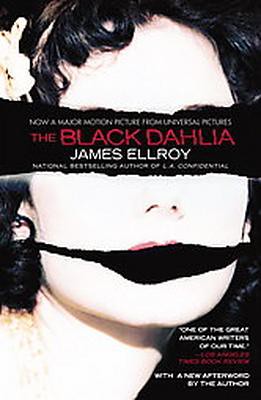
Last week, we entered the world of Ross MacDonald and Lew Archer, and took a tentative step toward James Ellroy's visceral vision of 1940s Los Angeles. Specifically, the author's terrific neo-noir and fictionalized examination of the death of Elizabeth Short, otherwise known as the Black Dahlia.

In the book -- aptly titled The Black Dahlia, natch -- Ellroy introduces the readers to Dwight "Bucky" Bleichert and Lee Blanchard, two up-and-coming cops on the L.A. police force. When the two cops -- who also both boxed before they joined the force -- face off in the ring to help promote a voting proposition to increase funding for the department, a bond is formed. Soon, the two become partners for the department's elite "Warrants" division, and Bucky finds himself immersed in his partner's day-to-day life, which includes his ravishing live-in girlfriend, Kay Lake. The three become irrevocably linked, and a strange co-dependent bond is forged. Lee supports Kay, Kay is falling for Dwight and Dwight is torn by his loyalties to his partner and his growing lust for his partner's pseudo-wife.
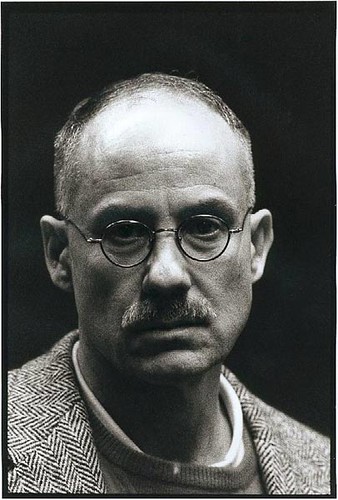


The dynamic is blown to bits on January 15, when while on a routine investigation Bucky and Lee stumble upon Elizabeth Short's dead and gruesomely dismembered body. Soon, the scene becomes a flashpoint for media and cops, and the story of "The Black Dahlia" murder is the talk of the town. Why was this pretty New England girl so brutally murdered? And, more importantly, why are both Bucky and Lee inexorably driven to find her killer?

What follows is a slow and thoughtful dip into the seedier realms of the human psyche, echoed by Ellroy's perverse vision of Los Angeles right after the second World War. Initially, the Dahlia murder serves as a uniting force for the Bucky/Lee team, but it soon becomes a growing crack in their equally flawed trinity with Kay. Lee, haunted by memories of his younger sister -- who was killed in a similar fashion to the Dahlia -- becomes obsessed with the case. Fueled by uppers and a twisted desire to put his dead sister's ghost to rest, Lee abandons his home and eventually his city on a quest to solve the murder.

Bucky, meanwhile, is at first reticent and dismayed at his reassignment from Warrants to the Dahlia case. But upon meeting the mysterious and sexy Madeleine Sprague on a canvass of a few LA dive bars, Bucky finds himself in a passionate and disturbing romance with the Dahlia's clown face-scarred visage and her sad demise. Madeleine's uncanny resemblance to the deceased Ms. Short, along with her own slowly-revealed machinations send the young cop into a tailspin that will eventually ruin his career, romantic prospects and obliterate his self-respect.

The Black Dahlia is a tour de force and Ellroy at his finest. It's the kind of book that not only paints a believable picture of a time long past, but also makes you long to be a part of that world, no matter how dirge-like and frightening it may seem. Ellroy's characters jump to life, whether it's through their actions or their tight, believable dialogue and mannerisms. Ellroy's L.A. is a bloody, infected scratch of a town, littered with floozies, two-faces and sad, wretched people clinging to their very existence with a slurred and medicated desperation. You may not like any of the characters in the book, you may not like any of their actions and you may be scared and shocked by what you read, but you won't be able to put it down. This book cuts to the core of human nature, and it isn't a pretty picture.

The Black Dahlia is a tale of extreme, deadly obsession and sharply focused longings and desires, with a sinful metropolis as its dangerous and malignant backdrop.

I'd end my writing here, but there are a few more notes I want to touch on. Not nearly as exciting as the book itself, though.
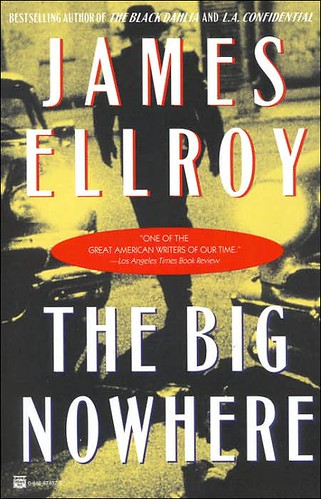


As some of you might know, The Black Dahlia is the first part of what Ellroy later dubbed "The L.A. Quartet," which also includes The Big Nowhere, L.A. Confidential and White Jazz. Needless to say, I'll be picking up The Big Nowhere the next time I step into a bookstore (*cough*today*cough*), and proceeding from there.
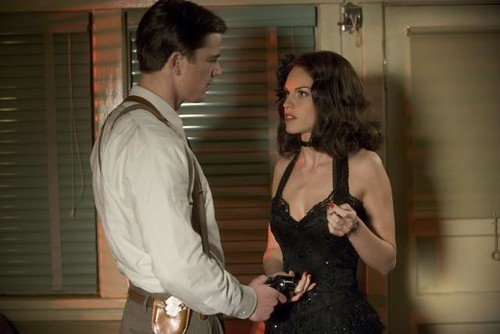


Additionally, the novel was adapted by director Brian De Palma into a piss poor movie, starring doe-eyed Josh Hartnett and a stuffy Aaron Eckhart as Bucky and Lee, respectively. With the painfully numb and monotone Scarlett Johannsen dumbing down and neutering the Kay Lake role. The only highlight was Hillary Swank, who veered a little bit off her usual path of asexual tough girls by playing the vampy and over-sexed Madeleine. But Swank couldn't save the film, which ham-fistedly delivered the novel's more nuanced messaging and truncated the novel's thoughtful and effective ending to create something overwrought and lumbering at best, laughable at worst. I considered for a moment re-casting the film and making a blog post out of it, but in the end, it's best not to think of this adaptation at all, if one can help it.

One final note, this one a tad selfish -- I first went into reading Dahlia thinking it would offer little guidance in regards to my own work -- specifically Silent City -- thinking I'd mined the crime genre enough with Pelecanos' A Firing Offense and a few other books. But it really helped me determine a huge aspect of the book that had often bothered me -- why would Pete pursue Kathy's killer so diligently? What drives him? Needless to say, reading this book helped me figure that out for myself. An added bonus to an already great reading experience.

But, as usual, enough about me. What are you reading?

Tuesday, October 28, 2008

The Writing Wire for 10/28


Come and get it.

• Someone watched all the Saw movies and lived to talk about it. The Onion AV Club has the story.

• The New York Times punches holes in the painfully trite new cop movie, Pride and Glory by showcasing the worst genre cliches in the film. A sample:

The New York police story that sticks in the public consciousness usually includes some or all of these elements: THE CONFLICTED POLICE OFFICER, who is torn between enforcing the law and watching the backs of his relatives or buddies in homicide/narcotics/missing persons/the seven-six. By the way, he has “seen some things.” Not things like traffic on the Belt Parkway or a matinee performance of “Mamma Mia!” But things that he really, really doesn’t want to talk about. Just leave it alone. O.K.? Just leave it.

• Ken Levine reviews Diner.

• Guess what? Joss Whedon's Dollhouse almost did fall apart.

• Stephen King talks to Salon about The Stand, 30 years later.

• If you care, Times Online has 10 Things You Didn't Know About Pink Floyd.

• Continuing their great series on writing novels, PoeWar asks "How good is your bad guy?"

• The Corrections author Jonathan Franzen apparently hates everything.

• WTF? Led Zeppelin is getting back together? Apparently. And without Robert Plant!

• I Watch Stuff compares Star Trek promo shots, new and old. See above.

• Gawker ponders the question: Could Gus Van Sant's Milk suck?

• Film School Rejects thinks RocknRolla might be good.

SuckerFlix #3: The Squid and the Whale...and more


We're on a nice little streak here in SuckerFlix land, what with Before the Devil Knows You're Dead last week and the mini-trifecta I'll be talking about shortly.

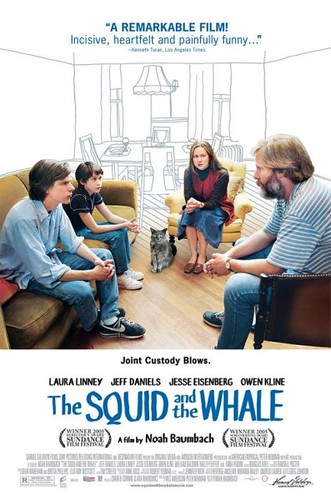
I'll devote the bulk of this space to The Squid and the Whale, which was excellent in every way except timing -- which is on me. Don't watch this movie first thing in the morning. Well, not if you plan on interacting with other human beings at some point that day. I made the mistake of putting it on while I sipped my morning coffee and tweaked the SILENT CITY outline and ended up in a morose, pensive and almost cranky mood. A testament to the strength of the film.

Squid starts quietly enough. Jeff Daniels and Laura Linney star as a couple stumbling toward a messy divorce, with two adolescent boys caught in the crossfire. The film does a great job of painting a picture of a fragmented family, where nothing is really black and white (despite the kids' repeated efforts in the story to make things so) and there are few villains but even fewer heroes. Linney is her usual, top-notch self, bringing a touching and very real vulnerability to her character without losing herself in bawling cliches or overwrought melodrama. Being a product of a divorced home myself, I found the film's portrayal of a once tight family's dissolution rang true. The movie never sinks into soap opera, nor does it dovetail toward a convenient resolution. These are real people in real life, and like real life, nothing is really all that tidy or neat. There are mostly grays as opposed to swaths of black and white.


I have to say I was pleasantly surprised by Jeff Daniels' performance as the egocentric and detached father, who struggles with his fading reputation as Linney's character's profile rises in the literati circles both dwell in. My experience with Daniels is, sad to say, really limited to his comedic work and the mediocre Blood Work, so it was great to see him really nail a part and show his chops. It really presented him in a totally different light.

Anna Paquin is serviceable as Daniels' sexy student, but her scenes are by far the most predictable and least interesting. It's no surprise that the eldest son falls for her, or that (spoiler!) Daniels does too, so I really just found myself hoping she would become less central to the plot and the story would spend more time with Linney, who really steals the show without even trying. The most touching and funny scene can be found in the last quarter of the film, where a despondent Daniels admits to Linney he'd like to give their union another try, which leads Linney to burst out laughing. It's a scene that is almost clouded by its own simplicity. Linney makes the laughter seem so easy and natural that you forget you're watching a movie, instead you're in a friend's living room at an awkward moment.

I'd be remiss if I didn't mention the two boys, played ably by Jesse Eisenberg and Owen Kline. Both really act above and beyond their ages, and bring a believable sense of quiet pain and confusion to their characters, which they each reveal and express differently. While Daniels and Linney carry the film, it's the kids that make it a joy to watch.

The Squid and the Whale is a conflicted, messy and real story of a family in disarray and a marriage at its end. Like the best kind of fiction, it reels you in and plops you into the world the writer and director have created, sometimes with jarring results. Just don't watch it in the morning. Trust me.

SuckerFlix Grade: A
Next Week: The Limey


Bonus feature! A few mini-reviews, since I managed to watch a ton of movies in the last week.


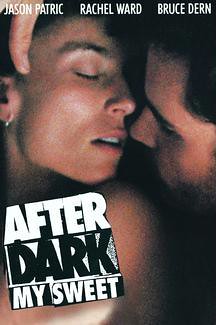
After Dark, My Sweet: Not nearly as gritty or compelling as the Jim Thompson novel it's based on, Sweet feels forced from the beginning. Jason Patric gives a stilted, confusing performance as a nomad ex-boxer duped into a child kidnapping scheme. Rachel Ward is functional as the boozy love interest, but the plot meanders and dawdles in a way the book never does. The bright lighting and art deco fashions and decorations don't help, either. A passable film overall, but inexcusable for its mismanaging of strong and compelling source material. C+


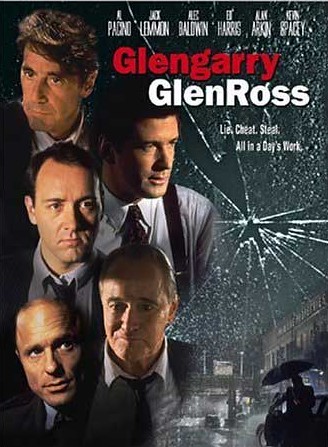
Glengarry Glenn Ross: I'm not going to waste much space here. Not because the movie doesn't deserve it -- it does, in spades. But what can I really say about a film classic? The cast, featuring Pacino, Ed Harris, Jack Lemmon, Kevin Spacey an Alec Baldwin is top-notch, and they deliver. If you haven't seen this movie, go out and rent it now. This review will be here when you get back. A+

In the meantime, I'll share Baldwin's riveting opening scene.