Saturday, October 04, 2008

Trailer Trash XIV: The Thing With Two Heads (1972)


"They transplanted a white bigot's head onto a soul brother's body!"

And when that happens, y'all can guess that antics ensue. You'd like to think that this is one of those movie premises they only could have gotten away with making several decades ago, but that's not a true statement at all. If they were to shoot this now, it would probably just star Snoop Dogg and Rob Schneider.

The real star of the trailer you're about to watch is far and away the hilariously terrible costume. In 1972, special effects had not yet progressed past having two guys stand really, really close together and throwing an extra-large coat over them.


At 0:06 - When did it ever seem like a good idea? To whom? Did ANYONE think this through?
At 0:26 - Wouldn't just about EVERYONE suspect that they wouldn't care for the idea much?
At 0:36 - Trust me, you'll never get tired of seeing them run around like that.
At 0:48 - Isn't his white head further back than it's supposed to be?
At 1:30 - Note the wicka-chicka-waka soundtrack. Yep, another movie from the 1970s.

Three facts about 'soul brother' Rosey Grier: 1) Grier was a two-time Pro Bowl tackle for the New York Giants and the Los Angeles Rams. 2) Grier was the Robert Kennedy bodyguard who wrestled the gun away from the senator's shooter and broke his arm to subdue him. 3) Grier is also the author of Rosey Grier's Needlepoint for Men:


Rosey Grier: Unquestional badass, macrame master.


"Now you KNOW you got to go!"

Friday, October 03, 2008

Ballast and The Pleasure of Being Robbed - Filmmaker discussions in NYC

These both look great - I wish I were able to make either screening this weekend!

BALLAST followed by Q&A with writer/director Lance Hammer


Saturday and Sunday, 10/4 and 10/5 at the Film Forum
After 8:00 PM shows
A young boy drifts through the spare flatlands of a wintry Mississippi township and a middle-aged man sits in his rural home, frozen in grief after his brother’s suicide. These striking images set in motion a riveting story of three people trying to reposition their lives after experiencing a traumatic loss. Lance Hammer has been compared to the Dardenne Brothers, for the assured hand with which he tells a delicate, quietly unfolding story using understated means and non-professionals from the Mississippi Delta. “The one indisputably great film at Sundance ’08… (This) poetic and profound movie transcends categories and announces the arrival of a major new filmmaker.” — Peter Travers, Rolling Stone.

THE PLEASURE OF BEING ROBBED followed by Q&A with writer/director Josh Safdie


Saturday, 10/4 at IFC Center
After 6:20 and 8:20 PM shows

The story of a young woman whose compulsive curiosity leads to bold, elaborate acts of theft, Josh Safdies THE PLEASURE OF BEING ROBBED is a beguiling blend of casual comedy and subtle, unsettling mystery. The film, the debut feature by 24-year-old New York writer-director Safdie, was the Closing Night film of the 2008 Cannes Directors Fortnight and the only film from the U.S. to play in that section.

Discussion and screening with writer/director Mike Leigh (Naked, Secrets & Lies, Vera Drake)


To top off the Museum of the Moving Image's Weekend With Mike Leigh screening series, on October 19th the Scandinavian House at 58 Park Avenue will host a screening of the new movie Happy-Go-Lucky followed by a discussion with the award-winning writer/director Mike Leigh.

If you aren't familiar with Mike Leigh's work, I'd recommend adding the dark drama Naked to your Netflix queue.

Tickets are available here.

Thursday, October 02, 2008

What, When, Where this Weekend - Rachel Getting Married, Ballast, Nick and Norah...

What, When, Where is a weekly guide to select screenings, discussions and events in the NYC-area of interest to screenwriters.

Opening This Weekend:

RACHEL GETTING MARRIED, dir. Jonathan Demme, written by Jenny Lumet


PREMISE: A young woman who has been in and out from rehab for the past 10 years returns home for the weekend for her sister's wedding.

PLAYING AT: Lincoln Plaza Cinemas, Regal Union Square

The film is directed by Silence of the Lambs' Jonathan Demme and has received pretty high praise in most reviews I've seen - many comparing it to gems directed by Robert Altman (here and here, for example). It doesn't hurt that it stars the oh-so-make-out-withable Anne Hathaway. (Cue inappropriate comment from Cake Man... NOW.)

This is the first feature for screenwriter Jenny Lumet, daughter of Dog Day Afternoon's (and many other films') Sidney Lumet - so we know she comes from good genes.

BALLAST, written and directed by Lance Hammer


PREMISE: A drama set in the Mississippi delta, where one man's suicide affects three people's lives.

PLAYING AT: Film Forum

The film was nominated for the Grand Jury Award at Sundance (ultimately losing to Frozen River). You can read This Savage Art's praise here.

NICK AND NORAH'S INFINITE PLAYLIST, dir. Peter Sollett, adapted by Lorene Scafaria


PREMISE:Nick and Norah’s Infinite Playlist is a comedy about two people thrust together for one hilarious, sleepless night of adventure in a world of mix tapes, late-night living, and, live, loud music.

PLAYING AT: Just about everywhere.

I like Michael Cera, but the trailers for this movie make it look too Juno-sugary for my tastes. This review certainly didn't make it look any more appealing to me:
"An emo cover version of a John Hughes comedy ... unless you believe that Death Cab for Cutie’s lyrics really speak to your life, Nick and Norah’s charms are frustratingly finite." - Time Out New York

BLINDNESS
, dir. Fernando Meirelles, adapted by Don McKellar


PREMISE: A doctor's wife becomes the only person with the ability to see in a town where everyone is struck with a mysterious case of sudden blindness. She feigns illness in order to take care of her husband as her surrounding community breaks down into chaos and disorder.

PLAYING AT: Clearview Chelsea, AMC Loews

What're you seeing this weekend?

Wednesday, October 01, 2008

5 Things to Watch Out For When Writing


ScriptXRay, an online resource dedicated to the exploration of and craft of screenwriting, recently posted an article on “TIPS: 5 Things Not to Include in Your Screenplay.” Of course, there are exceptions to every rule, but the five things listed are either going out of fashion or instantly mark a writer as an amateur. According to cj Rice and the gang over at ScriptXRay, writers should do everything they can to avoid:

1. Inserts
2. Micro-description
3. Capitalizing sound
4. Music
5. Camera direction

I won’t spend too much time breaking each of the five down, since you can read all about them here. However, I’d like to talk about a few of them as they relate to my own experience. The article defines micro-description as follows:

“You’ve heard of micromanagement, right? Not fun is it? Well screenwriters have their own form of this, and it’s called micro-description, and it forms when a screenwriter describes each and every movement, beat by beat, moment by moment, scene by scene.”
I’ll admit, I’ve been very guilty of this in the past, especially during the first and even second draft of my comic book style spec. At one point, I’d devoted an entire page to what would have amounted to maybe a ten second fight – if that. BIG no no. What was worse was that when I tried to address the issue, I went too far toward the other extreme, I guess what you could call “under-description” (from the term 'under management'). I remember actually writing, at one point during a fight scene, “He punches and kicks, is kicked and punched,” or something like that. AAAAGH!

I think that draft has been burned. Needless to say, I don’t do that anymore, either.

Finally, I just want to touch on capitalizing sound, since that’s something that’s been on my mind a lot recently. More and more, I read about how the industry, especially producers, is turning away from this practice. I still do it, not because I’m a rebel or I’m wedded to it, but because it’s what I was taught to do. It’s only been relatively recently that I’ve seen this brought up as a red flag – maybe it’s been discussed for years, only I just started hearing about it. I’d like to think that a perfect script would still get produced, even with capitalized SOUND. Have any of you readers heard more about the debate or experienced the impact of the trend? I’d be curious to know.

Again, check out the full article from ScriptXRay here.

Tuesday, September 30, 2008

Spike's New Joint Just Won't Hit


So Cake Man asked me to write a movie review for Miracle at St. Anna, the new Spike Lee joint. I haven't written a movie review since my high school newspaper days. Training Day was the last one if I remember correctly. I'm pretty sure I gave it a B+. I know, who scores movies with letter grades? I guess you could say it was fitting of the academic setting. But the review and score were fair I thought. You gotta love Denzel Washington. It would have been nice to see him in St. Anna. Not that he had to be the star or anything, maybe just a veteran soldier. I wouldn't be surprised if Spike asked, but to be honest, if he did ask, I don't think Denzel is kicking himself for not signing up.

Miracle at St. Anna is set during WWII and follows a group of four African-American soldiers who get separated from their unit and hold up in a small town in the Tuscany region of Italy. During their time there they befriend the locals, explore the reality that they are more accepted in a foreign country than in their own, and shepherd a boy whose eyes and soul bore witness to horrific events at the nearby town of St. Anna.

A common word I found in published and broadcast reviews of St. Anna is "meandering". I think use of the word is justified for two reasons. The first reason is that the movie has several awkward jumps in tone. One moment you are bearing witness to the horrors of war (I enjoyed Spike Lee taking time and care to show us dead African-American soldiers from WWII, a rare sight in film) and in another moment, seemingly without transition, you're torn between enjoying and disliking jovial, comical, and sometimes oddly spiritual banter between the main characters.

The second reason the flick wanders a bit is what I think hurts it the most. I wasn't prepared for a film that wasn't anchored more solidly to a story purpose for its characters. I won't compare it to other war movies, but I felt like the characters spent a great deal of time just hanging out, satisfied with the fact that they were representing something that had to this point been left unrepresented. I didn't necessarily need to see more gunplay or explosions, but something that would have gotten our characters to lock and load and set out to change their world. I immediately became more invested when the soldiers were given the difficult order of capturing a German soldier. The story manages to bring our main characters a German prisoner without them lifting a finger.

My next biggest gripe would have to be the score. At times it was spot on, but there were other moments where its trumpety sound almost felt like something out of classic James Bond. There were scenes that just became cartoonish, the serious energy sucked right out of it. I fond myself frequently wondering what the movie would have felt like with a different, or somewhat adjusted soundtrack.

Few other quick gripes. There were so many story elements, most of which I appreciated, but I definitely wanted a better allocation of time when it came to some. The framing story was paced well during the beginning, but deserved more time towards the end, a move that I felt would have been more rewarding to the audience. It was odd that it wasn't made clear who the protagonist from the framing story was once we moved to the war portion of the story. If you were paying close attention to detail it was there, but that was something I would expect any director to make pretty obvious up front. But then again my brother felt that it could have been intentional and part of the movie experience. I'm not sure I agree. Lastly, one of the big revelations, and the film treats it us such, came off as not so big. If you've seen the movie you know what I mean. Maybe I missed it. I hope I did.

Yeesh. Looking back on all this I wish I had spent more time talking about what I liked about the movie. I blame it on the league and all the time we spend in our meetings tearing our scripts apart. I will say this. Spike Lee set out to represent the WWII era African-American soldier on film. He did so boldly and admirably, but you can't help but get the sense as you go along that Spike is stepping way out of his element. A part of me just wishes that Spike didn't have to be the one forced to step up to do the job that nobody else seemed willing to do. WWII is one of the most molested and prodded subject matters in history. Its examination extends deep into literature, art, music, video games, and film. It's a little sad that some elements (and not only African-American soldiers) still go largely unrepresented. I could give an example, but I'm hoping it will be my breakthrough script a few years from now. Spike did his part, and I hope writers and directors down the road will do theirs. We should see a great story first, before seeing the color or gender attached.

What are you reading? Week 3: Goodbye Harry Bosch, hello ex-junkie journalist bio


Last week, I was in the midst of finishing off The Narrows, another Michael Connelly Harry Bosch novel that also featured guest appearances by some of his non-Bosch novel characters, most notably FBI Agent Rachel Walling and -- to a degree that I won't reveal because it's spoiler-y -- retired FBI Agent Terry McCaleb. Since then, I've plowed through the rest of The Narrows and finished off Connelly's remaining three Bosch novels, The Closers, Echo Park and The Overlook. I won't go into overly detailed reviews of the three, not because they weren't good, but because I'm more interested in talking about the book I'm reading now.

Of the three, Echo Park was by far the most enjoyable and readable, with the other two serving as functional but not remarkably outstanding Bosch adventures. The Overlook, which was originally published in serialized form in The New York Times Magazine clocked it at barely under 300 pages, which is fairly light for a Connelly book, and read more like it was setting up Bosch's new status quo (new partner, new assignment, old love interest) than really telling an exciting or thrilling adventure. Don't get me wrong -- I enjoyed all three books a great deal. But, if I had to choose which of the three came closest to some of my personal Bosch favorites (Concrete Blonde, Lost Light, A Darkness More Than Night and, to a degree, The Narrows), it'd probably be Echo.

But after finishing The Overlook I found myself without a new Bosch book to read, which allowed me -- for the first time in a few months -- the opportunity to take a detour outside of the crime fiction/detective genre and work out some of the reading muscles that got lazy while I read about forensics and private eyes.

The first book I went to was David Carr's The Night of the Gun. David Carr, as some of you may know, is a columnist for The New York Times. Most importantly, though, Carr is also a recovering crack cocaine addict. The Night of the Gun tells the horrible, gruesome tale of his descent into addiction. The unique part of the memoir, though, is that Carr actually went back and spoke to the people who he interacted with during his time as a junkie failure -- the woman who gave birth to his twin daughters while both of them were daily crack fiends, the well-known comedian who once tried to gouge Carr's eye out because he was nagging the funnyman about a coke debt and the dealer who Carr went to score from while his twin, four-month old daughters waited in the car. In the winter. In Minnesota.
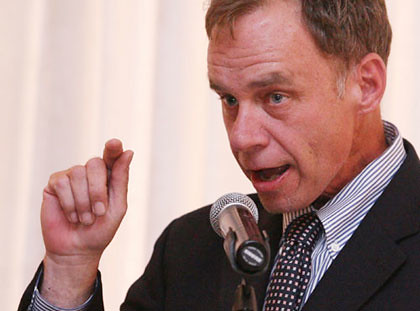


Truly jarring stuff, but Carr doesn't hold anything back in the telling and gives his interview subjects ample room to be critical and brutally honest about the author. And, in the process, you see how Carr himself has changed, but also how he is being changed by the process of re-living his life. Imagine waking up one day and realizing that, no, you're not the nice person you thought you were. Yeah, those two years you don't really remember? Well, you beat up women, drank and drugged to extreme excess, got arrested over a dozen times and failed at five stints in rehab. The story Carr tells, and the journalistic tools he uses to tell them paint a picture of a man who didn't reclaim his life because he's a great person -- although, from what I can tell, he became a better man -- but because of luck, and because he had caring friends and family. I'm only about 200 pages into the book, so I imagine there's more to be revealed. A friend of mine (who lent me the book) said there'll be at least one jaw-dropping moment toward the end. Which is somewhat frightening, because the pages I've already read have left me oftentimes with mouth agape and my eyes wide. I can't recommend this book any more. But enough of that.

What are you reading?