Monday, September 15, 2008

Do you write with certain actors in mind?


Might not be the best idea, according to Alex Epstein, over at Complications Ensue, a pretty entertaining screenwriting blog. His advice:
Don't get cute with the character names, it'll be distracting.

One danger in writing for a specific actor is you might not make the character strong enough. Knowing that Will Ferrell can make lots of unfunny things semi-funny, you might not sharpen the gags up enough for the read.

Another is, what if they're looking for a vehicle for Seth Rogen?

I would just write the strongest comic character you can, and let them figure out who it would be great for.

Or, if they ask "Who are you thinking of?" you can tell them.

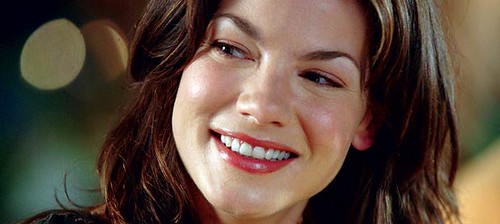
I'm not sure I totally agree, at least from a prose perspective. Hell, I've cast SILENT CITY in my head, with Ms. Monaghan, above, in a starring role (because I enjoyed her in both Gone, Baby Gone and Kiss, Kiss, Bang, Bang -- both modern and noir-ish stories that matched some of the things I want SILENT CITY to do, in an ideal world).

I find it helps to visualize certain people doing certain things. I think as long as you use it as a tool to further you writing, and less about hoping Will Ferrell will actually be in your movie, then you're OK. Once the fantasy starts to alter the course of the reality -- of writing, and telling a functional story, that is -- you've lost it.

On a related note, this post got me to thinking about how other people read their fiction. I know that I often "cast" actors while I'm reading a novel, unless there's already a pre-existing movie or TV adaptation that I can reference (and, of course, agree with). For example, I always picture Ed Harris as Connelly's Harry Bosch:


Do you do the same? Curious to hear some examples.

Sunday, September 14, 2008

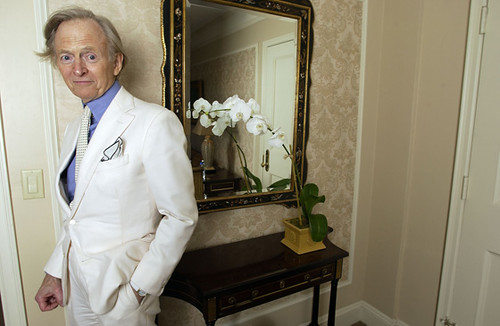
Tom Wolfe: Fiction today sucks


Noted author Tom Wolfe, on the state of fiction in an interview with Time Magazine:
"There's so little of it now that it's pathetic, and it's pathetic all over. Writers come from master of fine arts programs now. If you add up the college education of Steinbeck, Hemingway and Faulkner, you get to spring break of freshman year."
Harsh. Do you agree?

[Via Jacket Copy]

David Foster Wallace, R.I.P.


Sad news tonight -- writer David Foster Wallace was found dead in his home. From the AP:

David Foster Wallace, the author best known for his 1996 novel "Infinite Jest," was found dead in his home, according to police. He was 46.

Wallace's wife found her husband had hanged himself when she returned home about 9:30 p.m. Friday, said Jackie Morales, a records clerk with the Claremont Police Department.

Wallace taught creative writing and English at nearby Pomona College.

"He cared deeply for his students and transformed the lives of many young people," said Dean Gary Kates. "It's a great loss to our teaching faculty."

Wallace's first novel, "The Broom of the System," gained national attention in 1987 for its ambition and offbeat humor. The New York Times said the 24-year-old author "attempts to give us a portrait, through a combination of Joycean word games, literary parody and zany picaresque adventure, of a contemporary America run amok."

Published in 1996, "Infinite Jest" cemented Wallace's reputation as a major American literary figure. The 1,000-plus-page tome, praised for its complexity and dark wit, topped many best-of lists. Time Magazine named "Infinite Jest" in its issue of the "100 Best English-language Novels from 1923 to 2005."

I enjoyed Wallace's short stories a great deal, and always had him on my short list of novelists I wanted to spend more time with once I got the chance.

If you're looking for a good starting point, check out Girl With Curious Hair, a superb short story collection published in 1989.

Link roundup:

New York Times obit
The Onion A.V. Club obit
Sarah Weinman on DFW
L.A. Times' Jacket Copy book blog obit

Saturday, September 13, 2008

Trailer Trash XI: Queen Kong (1976)


"Queen Kong - the Liberated Lady Gorilla!"

Yep, this movie was made. Sometimes that's the best review you can give a film.

A short history: In 1976, a pretty mediocre remake of King Kong (no, not THAT mediocre King Kong remake) was made, produced by Academy Award-winner Dino De Laurentiis. Just a short flight across the Atlantic, a bunch of Brits set to work on a parody titled... get ready... Queen Kong.

The film existed more or less as a vehicle to make PMS jokes about a giant gorilla. In the movie, an effeminate hippie named Ray Fay (Ray Fay, get it? GET IT???) befriends a giant she-gorilla and they have many zany gorilla-centric adventures.


At 0:01 - Kong! Kong! Kong! Kong!
At 0:40 - Ray Fay and the Gorilla wink at each other, setting the tone for the whole movie.
At 0:46 - Notice as the T-Rex's face squishes inward as it's pounded on. Through no small feat of suck, the monsters in this movie are somehow less realistic than the ones in the 1933 original.
At 1:04 - OH GAWD THE TEETH, I AM BLIND
At 1:05 - Love the muzak soundtrack to this scene.
At 1:08 - OH MY EYES THOSE TEETH, WHY ARE THEY DOING THAT>!>??
At 1:11 - AND AGAAAIANIANNIIN
At 1:20 - No comment on that punch.
At 1:30 - Strange monster plant = perfect opportunity for gratuitous ass shot.
At 1:38 - Yep, Queen Kong wears a bra.
At 2:35 - I think that lady getting punched was possibly the first intentionally funny part of the trailer.
At 2:50 - Just in case we forgot this was a British movie.
At 3:10 - And again. They don't want you to forget where this movie was made.
At 3:25 - The Queen Kong Song was certainly snubbed by the Academy.


The film had sunk into obscurity when a lawsuit from Dino De Laurentiis severely limited its release to a few European countries.

Strangely, though...


... the movie gained a huge cult following in Japan in the mid-90s, which has slowly spread west. Why Japan? Who knows. (Rachel, I'm looking at you...?)


"She's in one of her moods again!"

Muderati on story structure, building a second act

Alexandra Sokoloff, writing at crime fiction blog Murderati, has been posting a series of pieces dissecting story structure and the elements of a strong, dramatic story.

She's just posted her thoughts on Act 2:

Act Two is summed up by the greats such as, like, you know, Aristotle - as “Rising Tension” or “Progressive Complications”. Or in the classic screenwriting formula: Act One is “Get the Hero Up a Tree”, and Act Two is “Throw Rocks at Him” (and for the impatient out there, like Toni, the end-skipper, I’ll reveal that Act Three is; “Get Him Down.”)

All true enough, but a tad vague for my taste.

So let’s get more specific.

The beginning of the second act of a book or film (30 minutes or thirty script pages into a film, 100 or so pages into a book) – can often be summed up as “Into the Special World” or “Crossing the Threshold”. Dorothy opening the door of her black and white house and stepping into Technicolor Oz one of the most famous and graphic examples… Alice tumbling down the rabbit hole is another. The passageway to the special world might be particularly unique… like the wardrobe in THE LION, THE WITCH AND THE WARDROBE; that between-the-numbers subway platform in the HARRY POTTER series; Alice again, going THROUGH THE LOOKING GLASS; the tornado in THE WIZARD OF OZ; the blue pill (or was it the red pill?) in THE MATRIX; or the tesseract in A WRINKLE IN TIME.

This step might come in the first act, or somewhat later in the second act, but it’s generally the end or beginning of a sequence – think of ALIEN (the landing on the planet to investigate the alien ship), STAR WARS, RAIDERS OF THE LOST ARC, going out on the ocean in that too-small boat in JAWS, flying down to Cartagena in ROMANCING THE STONE, flying to Rio in NOTORIOUS, stopping at the Bates Motel in PSYCHO. It’s often the beginning of an actual, physical journey in an action movie; in a ghost story it is entering the haunted house (or haunted anything). It’s a huge moment and deserves special weight.

Obviously, this is useful beyond the world of crime fiction, but fiction in general, in any form. Here are her thoughts on creating your first act.

And, you savvy Connelly fans will find a quick reference to our favorite anti-hero, Detective Harry Bosch, in the first section of the post, where Sokoloff responds to an email about characters changing over longer periods of time (many books vs. one). Interesting reading.

Friday, September 12, 2008

The latest on literary agents

GalleyCat has a nice roundup of literary agent news, including a literary agent's thoughts on Amazon's Kindle, why the industry is all about waiting and a few more points of interest. Read on, friends:

Over at the Guide to Literary Agents blog, Chuck Sambuchino announces the winner of the "Worst Storyline Ever" contest. Even though the winning entry will never get anywhere near an agent, somebody needs to sell this:

"After losing badly in The Kentucky Derby, a horse is sold to the glue factory where he is processed and bottled, and we follow the stories of everyone who uses the glue, from a nose-picking pre-schooler to a dyslexic kidnapper who glues cut-out letters on a ransom note, until the last drop is gone."

Curtis Brown agent Nathan Brandsford warns writers about the abuse of a certain phrase in queries. The fragile dreams of melodramatic writers around the world are shattered.

Thinking about buying a Kindle? Ask yourself, what do book agents think about this strange new device? Janet Reid from Fine Print blogs her answer.

Agent Kate Schafer meditates on the "glacial" pace of the book business. "If you want a career in publishing, get used to waiting," she writes, patiently.

Burn After Reading


From this week's Time Out New York:
Burn After Reading is a disposable lark, and it’s treated by the filmmakers as such; Forget After Seeing would be a far more honest title.

Yowch. Has anyone seen this yet who can give their opinion?